
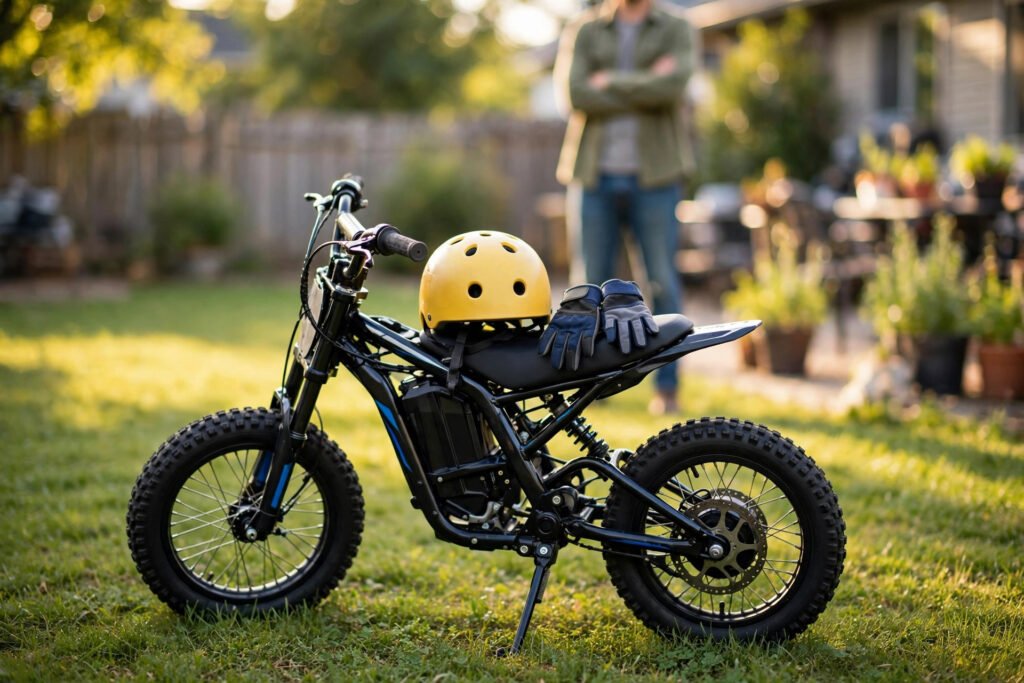
The best electric dirt bike for a 10 year old is the one that fits your child’s height and experience — not their age, and not the most powerful bike you can afford. Most 10-year-olds are between 4 ft 4 in and 4 ft 9 in tall, and that height range spans three different bike sizes. A child who can flat-foot a Talaria JR-16 will be terrified on a Surron Hyper Bee; a tall, experienced 10-year-old will be bored on a JR-12 within a month. This guide sizes bikes by rider height and experience, compares the real options from Surron, Talaria and E Ride Pro with verified specs and November 2026 prices, and covers the safety, gear and parental controls that matter far more than top speed.
A note for parents before anything else: an electric dirt bike is a real motorised vehicle, not a toy. Even a “kids” bike can reach 25–40 mph and weighs 24–115 lb. Every child on this list needs a helmet, boots, gloves and adult supervision, a safe place to ride, and a parent who understands the bike’s power modes. If you are buying your child’s first powered bike, read the safety section before you read the bike reviews.
Size first: how to fit a 10-year-old
Age is a poor guide to bike size. Two 10-year-olds can differ by 6 inches in height and 30 lb in weight. Fit by these three measurements instead:
1. Seat height vs inseam. Your child should be able to put both feet flat on the ground while sitting on the bike, or at least the balls of both feet firmly down. If they are on tiptoes, the bike is too tall — they will not be able to catch it when it tips, and every stop becomes a fall. Measure inseam (crotch to floor, barefoot) and compare it to the seat height: inseam should be equal to or greater than the seat height for a first bike.
2. Weight vs bike weight. A 10-year-old typically weighs 60–90 lb. A bike that weighs more than the child — such as a 115 lb Talaria X3 Mini for a 70 lb rider — is a bike the child cannot pick up, cannot push, and cannot control if it falls on them. For a first bike, the bike should weigh no more than roughly the child’s weight, and ideally less.
3. Reach and strength. Can your child reach the handlebars comfortably with a slight bend in the elbows? Can they squeeze the brake levers fully with one hand? Can they hold the bike upright on a slope? If any answer is no, the bike is too big — regardless of what the age label says.
Typical 10-year-old sizing:
| Rider height | Inseam | Best bike size | Seat height range |
|---|---|---|---|
| Under 4 ft 5 in (135 cm) | Under 20 in | Small youth (JR-12, balance bikes) | 17–20 in |
| 4 ft 5 in – 4 ft 8 in (135–142 cm) | 20–24 in | Mid youth (JR-16, Hyper Bee) | 19–27 in |
| Over 4 ft 8 in (142 cm) | Over 24 in | Large youth / small adult (Hyper Bee, X3 Mini) | 27–30 in |
Most 10-year-olds land in the middle row. If your child is tall for their age and has ridden before (bicycle, balance bike, small petrol bike), the large-youth row may fit. If they have never ridden anything powered, start in the middle row even if they are tall — skill matters more than height.
The shortlist at a glance
| Bike | Price (Nov 2026) | Seat height | Weight | Top speed | Power | Best for |
|---|---|---|---|---|---|---|
| Talaria JR-12 | ~$1,015 | 17.7 in | 24 lb | 10 mph | 0.36 kW peak | Small / first-time 10-year-olds |
| Talaria JR-16 | ~$1,397 | 19.7 in | 33 lb | 10 mph | 0.72 kW peak | Most first-time 10-year-olds |
| Surron Hyper Bee | $2,799–$3,050 | 26–28 in adjustable | 86 lb | 40 mph (2026) | 8 kW peak | Tall / experienced 10-year-olds |
| Talaria X3 Mini | ~$2,999 | 30.3 in | 115 lb | ~40 mph | 6 kW peak | Tall, confident 10-year-olds |
| E Ride Pro Mini R | Check dealer | ~27 in* | ~85 lb* | ~30 mph* | ~5 kW* | Experienced young riders |
| Talaria XXX | ~$3,500 | ~31 in* | ~120 lb* | ~47 mph | 6 kW peak | Only for big, experienced 12+ — see below |
*Figures marked with an asterisk could not be verified against a manufacturer listing in November 2026 — confirm with the dealer before buying. The E Ride Pro Mini R and Talaria XXX are included because parents ask about them constantly, but they are not our first recommendation for a typical 10-year-old.
1. Talaria JR-16 — the best first electric dirt bike for most 10-year-olds
The JR-16 is the bike most 10-year-olds should start on. It is a genuine kids’ dirt bike — 33 lb, a 19.7 in seat, a 10 mph top speed and a 16-mile range — built by Talaria, the same company that makes the adult Sting. That matters: the JR-16 is not a toy-store bike with a Talaria sticker. It has proper brakes, a proper throttle, and a build quality that survives being dropped repeatedly, which is what a 10-year-old’s first bike is for.
The 10 mph top speed is the key feature, not a limitation. A child learning throttle control, braking and balance does not need speed — they need a bike that cannot surprise them. The JR-16’s low speed means falls happen at running pace, not at road speed, and the 33 lb weight means your child can pick the bike up alone. The 16-mile range is more than enough for an afternoon of riding.
The honest downside is that a fast-growing or experienced child will outgrow the JR-16 within a year or two. That is not a flaw — it is the nature of kids’ bikes. Buy used if you can find one in good condition, and sell it on when your child moves up. The JR-16 holds its value well precisely because every parent of a 9-to-11-year-old wants one.
Buy it if: your 10-year-old is a first-time powered rider, or under about 4 ft 8 in. Skip it if: your child has already ridden powered bikes for a year or more and is tall for their age — look at the Hyper Bee instead.
2. Talaria JR-12 — for smaller 10-year-olds and complete beginners
The JR-12 is the smaller sibling: 24 lb, a 17.7 in seat, 10 mph, and a 9-mile range, at about $1,015. It is built for riders from about 3 ft tall, which makes it the right bike for a smaller 10-year-old — particularly a child under 4 ft 5 in — or for a child who is nervous and needs the smallest, lightest possible start.
For a typical 10-year-old the JR-12 will feel small quickly, and the 9-mile range is short. But for a first bike, “too small” is a much safer problem than “too big”. A child who masters the JR-12 in three months and moves up confident is in a better place than a child who spends six months scared of a bike that is too tall. If your child is on the smaller side or has never ridden anything with a motor, the JR-12 is the right call.
3. Surron Hyper Bee — for tall, experienced 10-year-olds only
The Hyper Bee is the most misunderstood bike on this list. It looks like a kids’ bike — 86 lb, a 26–28 in adjustable seat, 14/12-inch wheels — and it is marketed for younger riders. But it makes 8 kW peak, the same as a full-size adult Light Bee X, and the 2026 version claims a 40 mph top speed. A low seat does not mean a gentle bike. The Hyper Bee is a real dirt bike that happens to be small.
For the right 10-year-old — tall (over 4 ft 8 in), experienced (a year or more on a smaller powered bike), and supervised — the Hyper Bee is superb. It has three power modes, adjustable throttle response, wheelie control and a remote control function that lets a parent limit the bike. It is also the bike your child will not outgrow for years: it is genuinely capable on trails, not just in the backyard.
For the wrong 10-year-old — a first-time rider, or a child who is small for their age — the Hyper Bee is too much bike. Eight kilowatts in the hands of a 70 lb child who has never used a throttle is a recipe for a crash. If you buy a Hyper Bee for a 10-year-old, use the parental controls, start in the lowest power mode, and supervise every ride for the first month. The bike’s 121 lb maximum rider load also means it is a bike for children, not for adults — do not buy one as a shared family bike for a parent to ride.
Prices in November 2026 ran about $2,799–$3,050, with some dealers listing the 2026 model at $3,999 including freight and setup — the spread reflects different model years (the 2026 bike has a 58V 22Ah battery and 40 mph; the 2025 has a 50.4V 25Ah battery and 34 mph) and different included fees. Ask which model year you are buying.
4. Talaria X3 Mini — the big step up
The X3 Mini is the largest bike a 10-year-old should consider, and only a tall, confident, experienced one: 115 lb, a 30.3 in seat, a 6 kW motor and a claimed 40 mph top speed, at about $2,999. It is essentially a scaled-down adult Sting, with proper suspension and brakes and a range that covers a full afternoon of trail riding.
The X3 Mini’s problem for a 10-year-old is weight: at 115 lb it outweighs most 10-year-olds by 30–45 lb. A child who drops it on a trail cannot pick it up alone, and a child who falls with it underneath them is dealing with a serious weight. For a 12-year-old it is a much better fit — see our 12-year-old guide — and for a 10-year-old it should be a “next bike”, not a first bike, unless the child is unusually tall, heavy and experienced.
5. What about the E Ride Pro Mini R and Talaria XXX?
Parents ask about both constantly, so here is the honest answer. The E Ride Pro Mini R is E Ride Pro’s youth bike, positioned as a smaller alternative to the Hyper Bee. We could not verify its current price, seat height or top speed against a manufacturer listing in November 2026, so we will not publish figures we cannot stand behind — check with an E Ride Pro dealer for the current spec sheet, and apply the same fitting rules as for the Hyper Bee: it is a real dirt bike, not a toy, and it suits experienced young riders rather than first-timers.
The Talaria XXX (about $3,500, 6 kW, claimed 47 mph) is an adult-sized bike that is sometimes bought for older children. For a 10-year-old it is too big, too heavy and too fast — full stop. It belongs in the 12-year-old guide as a stretch option for big, experienced riders, not in a 10-year-old’s shortlist. If a dealer suggests a XXX for your 10-year-old, find another dealer.
What about Razor, STACYC and the toy-store bikes?
You will see cheaper kids’ electric dirt bikes from Razor (MX350, MX650), STACYC (12eDrive, 16eDrive) and various Amazon brands, often for $300–$1,600. Some of them are fine machines for their purpose — STACYC balance bikes are genuinely excellent for 3-to-7-year-olds learning balance, and the Razor MX650 is a popular first powered bike. But this site covers the Surron, Talaria, E Ride Pro, Rawrr, 79Bike, Stark and Alta families, and the bikes on this page are the ones that belong to that world: full suspension, hydraulic brakes, lithium batteries, and a real upgrade path to adult e-motos. If your budget is under $1,000 and your child is a complete beginner, a Razor or STACYC is a reasonable starting point — just know that it is a different category of machine, and your child will outgrow it faster.
Safety: the section that matters most
Gear, every ride, no exceptions. A DOT-approved helmet that fits properly, goggles, gloves, motocross boots (not trainers), knee guards and a chest protector. A 10-year-old’s bones are still growing, and a crash that an adult walks away from can break a child’s wrist or collarbone. Budget $300–$600 for decent kids’ gear. Buy the gear before the bike’s first ride.
Parental controls are not optional. Use the bike’s lowest power mode for the first month. If the bike has a remote limit or a keyed speed limiter, use it. The Hyper Bee’s parental controls exist for exactly this reason. A child who has never used a throttle should not have access to full power on day one — that is not overprotective, it is how every responsible parent does it.
Where they ride matters as much as what they ride. A 10-year-old should ride on private land with permission, a designated off-road area, or a motocross track’s kids’ area — never on public roads, never on pavements, and never on trails shared with cars. Check local rules: some areas have minimum-age rules for motorised vehicles, and some require adult supervision at all times. Riding on private land requires the landowner’s permission.
Supervision means watching, not just being nearby. For the first month, watch every ride. You will see the mistakes before your child does — the target fixation, the panicked throttle grab, the feet coming off the pegs. Correct them gently and immediately. After a month of clean riding, you can supervise from a distance, but a 10-year-old should never ride alone in a remote area.
Teach the pre-ride check. Before every ride: tyres firm, brakes working, chain tight, bolts tight, battery charged, no warning lights, kill switch working. Make it a ritual. A child who checks their bike before riding is a child who will check it as an adult.
The first fall. It will happen, probably in the first week, probably at low speed. Your reaction matters more than the fall. Stay calm, check for injury, praise the attempt, fix the bike together, and get them back on the same day if they are willing. A child who is scared off bikes by a bad first fall often never comes back. A child who falls, laughs and gets back on has learned the most important lesson in the sport.
The learning plan: first month
Week 1 — flat ground, lowest power. 20–30 minute sessions on flat grass or dirt. Practise starting, stopping, turning and putting feet down. No hills, no jumps, no other riders. End every session with something the child did well.
Week 2 — gentle slopes and turns. Introduce gentle uphills and downhills, figure-eights, and riding over small bumps. Practise standing on the pegs. Keep speeds walking-pace.
Week 3 — a simple trail loop. A flat, open loop with no traffic and no steep sections. Introduce the idea of looking ahead (not at the front wheel) and of covering the brake. Still lowest power mode.
Week 4 — assessment. If your child is starting, stopping, turning and braking confidently, move up one power mode and extend the sessions. If they are still grabbing the throttle or freezing on slopes, stay in the lowest mode for another two weeks. There is no deadline — a child who takes two months to graduate from Eco mode is a child who will ride safely for years.
Costs: what a 10-year-old’s bike really costs
- Bike: $1,015 (JR-12) to $3,050 (Hyper Bee)
- Gear: $300–$600 (helmet, goggles, gloves, boots, knee guards, chest protector)
- Spares: $100–$200 a year (tubes, brake pads, grips, levers)
- Electricity: negligible — a JR-16 battery costs a few cents to charge; a Hyper Bee battery costs under 30 cents
- Total first year: roughly $1,500–$4,000 depending on the bike
Kids outgrow bikes. Buy with resale in mind: the JR-16 and Hyper Bee hold their value well because there is always another parent looking for one. Keep the bike clean, keep the paperwork, and sell it on when your child moves up — the net cost of a year on a JR-16 is often under $500 after resale.
Common parent mistakes
Buying the bike you want, not the bike your child needs. The Hyper Bee is exciting. The JR-16 is not. Buy the JR-16 anyway if your child is a first-timer — the Hyper Bee will still be there in a year, and your child will be ready for it.
Skipping the gear to afford the bike. A $3,000 bike with a $50 helmet is a bad decision. A $1,400 bike with $500 of gear is a good one.
Letting friends ride it. Other children have different sizes, different experience and different parents. Do not lend your child’s bike to a friend’s child — if they crash, it is your responsibility, and their parents did not agree to the risk.
Riding on the road. These bikes are off-road machines. A 10-year-old on a public road on an unregistered, uninsured electric dirt bike is a legal and safety problem in every US state. Do not do it, and do not let your child talk you into it.
Verdict
For most 10-year-olds, buy the Talaria JR-16. It is the right size, the right speed, the right weight, and the right price for a first powered bike. For a smaller or nervous child, buy the JR-12. For a tall, experienced 10-year-old who has already ridden a smaller powered bike for a year, buy the Surron Hyper Bee — with the parental controls on and the power mode at its lowest. And whatever you buy, buy the gear first, supervise every ride for the first month, and remember that the goal is a child who loves riding and rides safely for years, not a child who goes fastest on day one.
Frequently asked questions
What is the best electric dirt bike for a 10 year old?
The Talaria JR-16 is the best electric dirt bike for most 10-year-olds: 33 lb, a 19.7 in seat, 10 mph top speed and a 16-mile range, at about $1,397. It is a real dirt bike built by Talaria, sized for a child’s first powered riding. Smaller children should start on the JR-12; tall, experienced 10-year-olds can consider the Surron Hyper Bee.
How fast should a 10 year old’s electric dirt bike go?
For a first-time rider, 10 mph is the right top speed — fast enough to be fun, slow enough that falls happen at running pace. A child with a year of experience can move up to a bike with a 25–40 mph top speed, but only with parental power limits and supervision. Speed is the last thing a beginner child needs.
Is a Surron Hyper Bee too powerful for a 10 year old?
For a first-time rider, yes — it makes 8 kW peak, the same as an adult Light Bee X, with a 40 mph top speed. For a tall, experienced 10-year-old who has ridden a smaller powered bike for a year, it is appropriate if you use the parental controls and start in the lowest power mode. Never give a beginner child full power on day one.
What size electric dirt bike does a 10 year old need?
Fit by height, not age. Most 10-year-olds (4 ft 5 in – 4 ft 8 in) fit a bike with a 19–27 in seat height, such as the Talaria JR-16 (19.7 in) or Surron Hyper Bee (26–28 in). Your child should be able to put both feet flat on the ground while sitting on the bike.
How much does an electric dirt bike for a 10 year old cost?
From about $1,015 for a Talaria JR-12 to about $3,050 for a Surron Hyper Bee, plus $300–$600 for gear. A typical first setup (JR-16 plus gear) costs roughly $1,700–$2,000. Buying used and reselling when your child outgrows the bike can cut the net cost significantly.
Can a 10 year old ride an electric dirt bike on the road?
No. These bikes are sold as off-road machines, and a 10-year-old should ride only on private land with permission, designated off-road areas, or a motocross track’s kids’ area. Rules vary by state and by area — check local regulations before riding anywhere.
What safety gear does a 10 year old need for an electric dirt bike?
A properly fitting DOT-approved helmet, goggles, gloves, motocross boots, knee guards and a chest protector — every ride, no exceptions. Budget $300–$600 for decent kids’ gear. Trainers and a bicycle helmet are not sufficient for a powered dirt bike.
How long does a kids’ electric dirt bike battery last?
A Talaria JR-16 gives about 16 miles per charge; a JR-12 about 9 miles; a Surron Hyper Bee up to about 31 miles. Real range depends on the child’s weight, terrain and throttle use. Charging takes 2–3 hours. Electricity costs a few cents per charge.
Should I buy a used electric dirt bike for my 10 year old?
Yes — kids outgrow bikes quickly, so a used JR-16 or Hyper Bee in good condition is excellent value. Check the battery (does it hold a charge and deliver its claimed range?), the brakes, the throttle and the frame for crash damage. Buy from a parent whose child outgrew the bike, not from a stranger with no history.
When should my 10 year old move up to a bigger bike?
When they can flat-foot the bigger bike, pick it up alone, and ride the current bike confidently in its highest power mode — including starting, stopping, turning and braking without hesitation. For most children that is 12–24 months on a JR-16. Do not rush it: a child who is confident on a small bike learns faster than a child who is scared on a big one.
Related guides
- Best Electric Dirt Bike for a 12 Year Old (2026) — the next step up (this build, planned)
- Best Electric Dirt Bikes for Beginner Adults (2026) — for parents buying their own bike (this build)
- How to Ride an Electric Dirt Bike for Beginners — technique for new riders of any age (this build, planned)
- Best Kids Electric Dirt Bikes — the site’s kids overview (live on PumpFlow)
- Electric Dirt Bike Battery Guide — battery care and storage (live on PumpFlow)
Prices and specifications checked against manufacturer and US dealer listings, November 2026. Figures marked with an asterisk could not be verified — confirm with the dealer before buying. Always supervise children riding powered bikes.
