Are electric dirt bikes worth it? For most riders in 2026, yes — if you ride trails or private land, if you value quiet operation and low running costs, and if you buy the right bike for your size and terrain. But they are not worth it for everyone: a rider who does long enduro days far from a charger, a racer who needs a full day of motos, or a buyer who expects a $3,000 bike to match a $9,000 petrol motocross bike will be disappointed. This guide gives the honest answer — the real pros, the real cons, the actual five-year costs of electric versus petrol, and the rider profiles for whom an e-moto is the right buy and the wrong buy — with prices and specs checked in November 2026.
The short answer
Electric dirt bikes are worth it if: you ride trails, private land or a local track; you ride two to three hours at a time rather than all day; you want low running costs and minimal maintenance; you value quiet operation (neighbours, wildlife, trail access); and you are buying a bike from an established brand with parts support.
They are not worth it if: you need 100+ miles of range in a day with no charging; you race motocross competitively at a high level; you have no safe, legal place to ride off-road; or you are buying the cheapest no-name bike you can find and expecting Surron performance.
The rest of this guide is the evidence behind that answer.
The pros — what electric dirt bikes genuinely do better
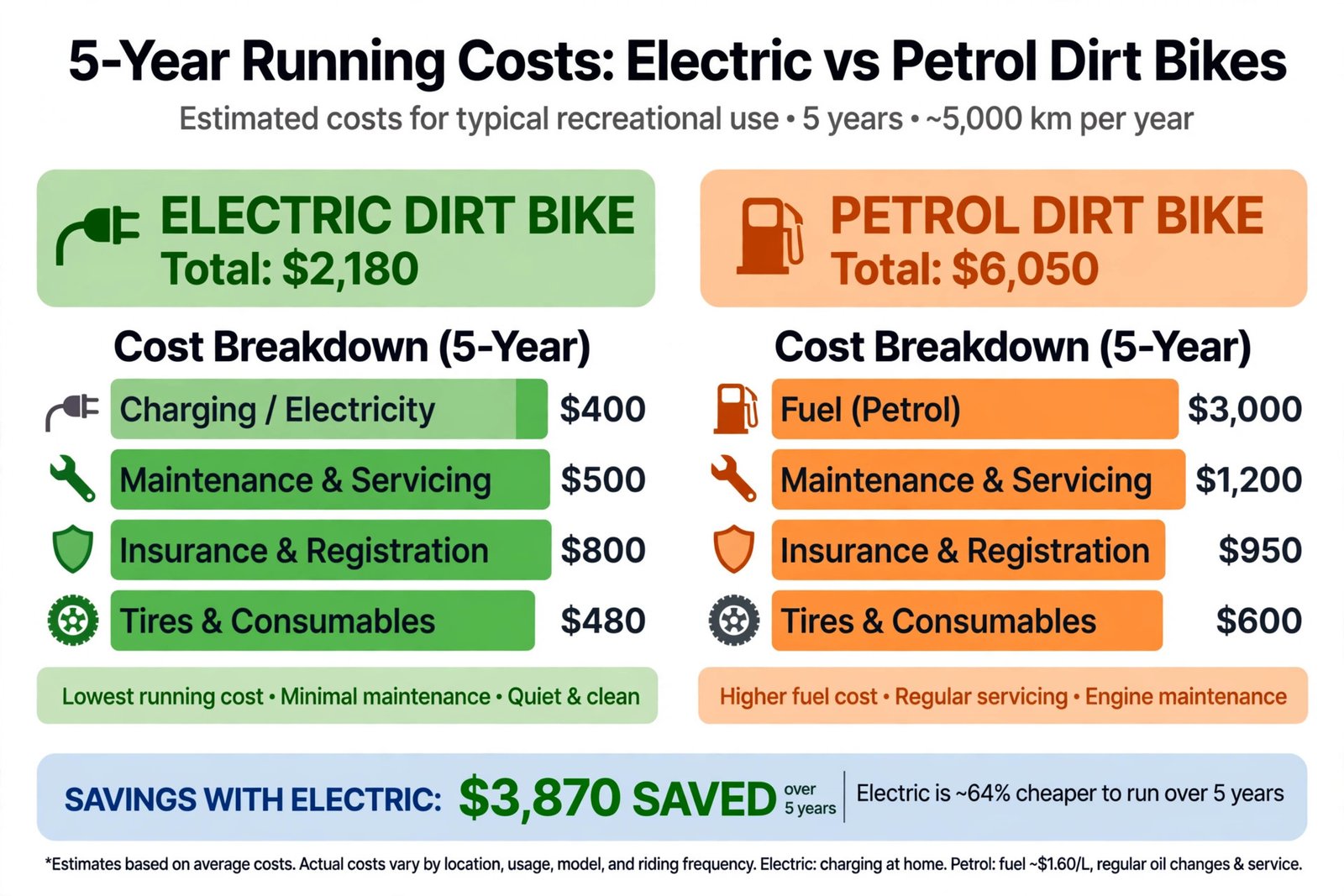
Running costs are dramatically lower. A full charge of a 2.4 kWh Surron Light Bee X battery costs roughly 40–70 cents at typical US residential electricity rates (about $0.17/kWh). Even the big 3.6 kWh E Ride Pro SS 3.0 battery costs under a dollar to fill. A year of weekend riding — say 50 rides — costs roughly $25–$50 in electricity. A petrol dirt bike doing the same riding burns roughly $15–$25 of fuel per ride, or $750–$1,250 a year. That is a saving of $700–$1,200 a year on fuel alone, every year you own the bike.
Maintenance is simpler and cheaper. An electric dirt bike has no engine oil, no air filter, no spark plug, no fuel system, no exhaust, no clutch and (on most models) no gearbox. The maintenance list is: chain and sprockets, brake pads, tyres, suspension service, and the battery. A petrol bike adds oil changes every 10–15 hours, air filter cleaning after every dusty ride, valve checks, top-end rebuilds every 50–100 hours on a two-stroke, and exhaust repacking. Over five years, a petrol bike’s servicing typically costs $1,500–$3,000 more than an electric bike’s — and that is before a single engine rebuild, which can cost $1,000–$2,500 on its own.
They are quiet. A petrol dirt bike produces 90–100 dB. An electric dirt bike produces roughly 60–70 dB — about the level of a normal conversation at distance. That matters in three ways: you can ride closer to home without angering neighbours, you are less likely to be banned from a trail area for noise, and you can actually hear your surroundings — other riders, wildlife, a mechanical problem developing. It also matters for the riding experience: many riders describe electric trail riding as calmer and more immersive, because you hear the tyres, the wind and the trail instead of an engine screaming.
Instant torque and no clutch. Electric motors make full torque from zero rpm. There is no clutch to manage, no gears to shift (except the Talaria’s gearbox, which is automatic in feel), and no stalling. For a beginner, that removes the hardest part of learning to ride off-road. For an experienced rider, it means precise low-speed control on technical terrain — you can crawl over a log at walking pace with perfect throttle control, something that takes years to learn on a petrol bike.
No fumes, no fuel storage, no warm-up. You can store an electric bike in a garage or a spare room without petrol fumes. You never mix two-stroke oil, never spill fuel, never flood a carburettor. You press a button and ride. For a rider with limited time — a parent with an hour after work, a rider who wants to squeeze in a quick session — that convenience is worth more than any spec sheet number.
They are easier to transport and store. Most e-motos weigh 120–170 lb, versus 220–250 lb for a full-size petrol dirt bike. They are easier to load into a truck, easier to carry up a ramp, and easier to store. The removable battery on most models means you can charge indoors, store the battery separately, and even carry a spare.
The cons — what electric dirt bikes genuinely do worse
Range is the real limitation. A Surron Light Bee X gives 25–35 miles of real trail riding. A Talaria MX4 gives 35–50. An E Ride Pro SS 3.0 gives 40–60. A petrol dirt bike with a 2-gallon tank gives 60–100 miles, and refuelling takes two minutes at any petrol station. If your riding is long-distance enduro, all-day desert, or multi-hour hare scrambles, an electric bike will run out before you do — and recharging takes 3–5 hours, not two minutes. Carrying a spare battery helps, but a spare costs $800–$1,500 and weighs 25 lb.
Charging takes time and planning. A full charge takes roughly 3–5 hours on a standard charger, depending on the bike and battery. You cannot “fill up” on the trail. That means you plan your rides around the battery, you charge the night before, and you do not decide at 9 am to ride all day. Fast charging exists for some models, but it is not universal, and charging a lithium battery quickly generates heat and can shorten its life if done constantly.
Battery replacement is expensive. A lithium battery lasts roughly 500–1,000 full charge cycles before its capacity drops noticeably — for a weekend rider, that is 5–8 years; for a daily rider, 3–5 years. A replacement battery costs $800–$1,500 for a Light Bee X or MX4, and more for larger bikes. That is the single biggest long-term cost of electric ownership, and it is the cost that petrol riders do not have. Budget for it from day one: set aside $150–$250 a year, and the replacement will not hurt when it comes.
Upfront cost is higher than a comparable used petrol bike. A new Light Bee X costs $4,000–$4,599. A good used petrol 250cc dirt bike costs $2,500–$4,000 and is faster, longer-ranged and fully supported by every dealer in the country. The electric bike wins on running costs over five years, but it loses on purchase price today — and for a buyer with $3,000 in their pocket right now, that matters.
Parts and dealer support are thinner. Surron has the best network in the e-moto world, and it is still far thinner than Honda’s or Yamaha’s. Talaria, E Ride Pro, Rawrr and 79Bike have fewer dealers, longer parts lead times, and less standardised servicing. If you live far from a dealer and cannot do your own maintenance, that is a real consideration. Check your nearest dealer’s distance before you buy, not after.
Resale is less predictable. The used e-moto market is young and volatile. A Light Bee X holds value well; a no-name bike does not hold value at all. Battery health dominates used pricing — a bike with a tired battery is worth little, and a buyer cannot always tell. Petrol bikes have a deep, stable used market with known values. Electric bikes are getting there, but they are not there yet.
They are not yet competitive at the top level of motocross. The Stark Varg ($11,990, 80 hp) is the exception — it is a genuine motocross race bike. But in the sub-$5,000 class, no electric bike matches a $9,000 petrol 450cc motocross bike for outright race performance, and the racing infrastructure (classes, rules, charging at the track) is still developing. If your goal is competitive motocross, a petrol bike is still the safer choice in 2026.
The five-year maths: electric vs petrol
Let us run honest numbers for a weekend trail rider doing 50 rides a year. All figures are estimates based on November 2026 US prices and typical dealer servicing rates; your costs will vary.
| Cost (5 years) | Electric: Surron Light Bee X | Petrol: 250cc trail bike (used, $3,500) |
|---|---|---|
| Purchase price | $4,300 (mid-range new) | $3,500 (good used) |
| Gear (first year) | $800 | $800 |
| Fuel / electricity | ~$200 (5 years) | ~$5,000 (5 years, $20/ride) |
| Oil, filters, servicing | ~$500 | ~$2,500 |
| Tyres, brakes, chain | ~$1,500 | ~$1,500 |
| Breakage / spares | ~$1,000 | ~$1,000 |
| Battery replacement (year 5–6) | ~$1,200 | $0 |
| Engine rebuild (petrol, once) | $0 | ~$1,500 |
| Total, 5 years | ~$9,500 | ~$16,300 |
The electric bike costs about $6,800 less over five years in this scenario — even after paying for a replacement battery and a higher purchase price. The gap widens if you ride more often, and narrows if you ride rarely (a rider doing 10 rides a year will not save enough on fuel to offset the higher purchase price).
But note what the table does not capture: the petrol bike’s longer range per ride, its two-minute refuelling, its deeper dealer network, and its stronger resale market. The maths favours electric; the convenience, for some riders, still favours petrol.
Break-even point: for a rider doing 50 rides a year, the electric bike typically breaks even against a comparable used petrol bike in year 2–3. For a rider doing 20 rides a year, break-even is year 4–5. For a rider doing 5 rides a year, the electric bike may never break even on cost alone — buy it for the quiet, the convenience and the fun, not for the savings.
Electric vs petrol: the riding experience
Numbers aside, the bikes feel different, and the difference matters more than the maths for most riders.
On the trail, an electric bike is calmer. You hear the trail. You can talk to your riding buddy at a stop without shouting. You do not smell of exhaust at the end of the day. The power delivery is smooth and precise, and the lack of a clutch means you never stall on a hill — the single most common beginner frustration on a petrol bike.
On the road to the trail, a petrol bike is easier: fill up anywhere, ride further, no charging plan. An electric bike needs a charged battery and a plan. If your riding involves a long drive to a remote trailhead with no power, a petrol bike is simpler.
In the garage, an electric bike is easier: no fuel, no oil, no fumes, no winterisation beyond battery storage. A petrol bike needs stabiliser in the fuel, oil changes, and a dry place to sit — and it will still be temperamental after three months idle. An electric bike that has sat for three months needs a battery top-up and a tyre check, and it is ready.
For learning, an electric bike is better. No clutch, no stalling, instant torque, quiet operation, and a low-speed mode that makes the bike gentle. A beginner learns faster on an electric bike and crashes less often in the first month — and the crashes they do have happen at lower speeds, because the bike is easier to control.
Who should buy an electric dirt bike?
The trail rider. You ride singletrack, fire roads and private land, two to three hours at a time, and you value quiet operation and low running costs. An electric bike is made for you.
The beginner adult. You have never ridden off-road, and you want the easiest possible start. An electric bike’s no-clutch, no-stall, gentle-mode learning curve is the best in the sport.
The time-poor rider. You have an hour after work or a Saturday morning, and you want to ride, not maintain. An electric bike is ready when you are.
The neighbour-conscious rider. You live near other people, or you ride near houses, and noise matters. An electric bike keeps the peace.
The parent buying for a child. A kids’ electric bike (JR-16, Hyper Bee) is safer, quieter and easier to supervise than a petrol kids’ bike, and the parental power controls are a genuine safety feature.
The heavier rider who wants low running costs. The E Ride Pro SS 3.0’s 302 lb load limit and 3,600 Wh battery make it the best heavy-rider e-moto, and its running costs are a fraction of a petrol equivalent.
Who should NOT buy an electric dirt bike (yet)?
The long-distance enduro rider. If your rides are 80+ miles with no charging, an electric bike will not do the job in 2026. A petrol bike, or a second battery and a charging plan, is the answer.
The competitive motocross racer. Unless you are buying a Stark Varg, a petrol bike is still the safer competitive choice — for performance, for class availability, and for trackside support.
The rider with no legal place to ride. An electric bike does not solve access. If you have nowhere legal to ride off-road, do not buy any dirt bike — electric or petrol — until you do. Join a club, find a track, get permission on private land.
The buyer chasing the cheapest possible bike. A $1,500 no-name electric dirt bike with no parts support is not worth it at any price. It will break, you will not be able to fix it, and you will have spent $1,500 on a lesson. Buy from the seven brands in this guide, or do not buy electric.
The rider who does five rides a year. If you barely ride, the running-cost savings will never offset the higher purchase price. Buy a good used petrol bike, or rent, until you know you will ride regularly.
What to buy if you decide yes
If this guide has convinced you, the shortlist is:
- Best all-round first e-moto: Surron Light Bee X ($4,000–$4,599) — lightest, best supported, easiest to resell
- Best value: Rawrr Mantis X ($2,999) — genuine 72V performance for the lowest price
- Best range: Talaria Sting R MX4 ($3,799–$4,500) — biggest 60V battery and a gearbox
- Best power per dollar: E Ride Pro SS 3.0 ($4,499–$4,999) — 15.8 kW and a 3,600 Wh battery
- Best for kids: Talaria JR-16 ($1,397) or Surron Hyper Bee ($2,799–$3,050)
Our buying guides cover each of these in depth: the beginner adults guide, the under-$5,000 comparison, and the trail riding guide.
Mistakes that make an electric dirt bike NOT worth it
Buying the wrong size. A bike that does not fit is a bike you will not ride. Sit on it before you buy. See our sizing guidance in the beginner and kids’ guides.
Ignoring the battery. Storing a lithium battery flat, or fully charged for months, or charging it in freezing conditions, shortens its life dramatically. Read our Battery Guide — it is the single most valuable article on this site for an electric bike owner.
Buying no-name. The seven brands in this guide have parts, dealers and communities. A no-name bike has none of those, and its “bargain” price is the most expensive mistake in this sport.
Expecting petrol range. If you buy a Light Bee X expecting 75 miles of trail range because the brochure says so, you will be disappointed. Buy on real-world range (25–35 miles for the Light Bee X), plan your rides accordingly, and you will be happy.
Skipping the gear. A $4,000 bike with a $50 helmet is a bad decision at any price. Budget $500–$1,000 for gear, and buy it before the first ride.
The future: will electric dirt bikes get better?
Yes, and quickly. Battery energy density improves every year, which means more range per pound and lower cost per watt-hour. Charging is getting faster. The dealer network is growing. The Stark Varg has already shown that an electric bike can compete with petrol at the highest level of motocross, and the sub-$5,000 class improves with every model year — the 2026 Light Bee X revision and the Talaria MX5 Pro are both substantially better bikes than their 2023 predecessors.
That does not mean you should wait. A bike bought today will still be a good bike in three years, and the riding you do in those three years is worth more than the incremental improvement you would get by waiting. The right time to buy an electric dirt bike is when you have a place to ride, the budget for the bike and the gear, and the time to use it.
Verdict
Are electric dirt bikes worth it in 2026? For a trail rider, a beginner, a time-poor rider or a parent, yes — decisively. The running costs are a fraction of petrol, the maintenance is simpler, the riding experience is calmer and more accessible, and the five-year maths saves roughly $6,000–$7,000 for a regular weekend rider. For a long-distance enduro rider or a competitive motocross racer, not yet — range and racing infrastructure still favour petrol, and the Stark Varg is the only electric bike that truly competes at that level.
The honest summary: an electric dirt bike is worth it if you buy the right bike, ride it where it is designed to be ridden, and look after the battery. Buy a Surron, Talaria, E Ride Pro, Rawrr or 79Bike — not a no-name — size it correctly, wear the gear, and the bike will pay you back in saved fuel, saved servicing, and rides you would not have taken on a petrol bike.
Frequently asked questions
Are electric dirt bikes worth it?
For most trail and recreational riders, yes. Running costs are roughly $25–$50 a year in electricity versus $750–$1,250 a year in petrol, maintenance is simpler, and the five-year saving over a comparable petrol bike is roughly $6,000–$7,000 for a regular weekend rider. They are not worth it for long-distance enduro or competitive motocross, where range and racing infrastructure still favour petrol.
Are electric dirt bikes cheaper to run than gas dirt bikes?
Yes, by a wide margin. Electricity costs well under $1 per full charge, there is no oil, no fuel mixing and no exhaust maintenance, and servicing is simpler. Over five years of weekend riding, an electric bike costs roughly $9,500 all-in versus roughly $16,300 for a comparable petrol bike — including a battery replacement for the electric bike and an engine rebuild for the petrol bike.
How long do electric dirt bikes last?
The bike itself — frame, motor, controller — can last 10+ years with normal maintenance. The battery is the limiting factor: roughly 500–1,000 full charge cycles, or 5–8 years for a weekend rider, before capacity drops noticeably. A replacement battery costs $800–$1,500. Motors and controllers rarely fail if kept dry and cool.
Do electric dirt bikes need a lot of maintenance?
Less than petrol bikes. The maintenance list is chain and sprockets, brake pads, tyres, suspension service and battery care — no oil changes, no air filters, no spark plugs, no fuel system and no exhaust. Budget roughly $200–$300 a year for consumables, plus suspension servicing every year or two.
Can electric dirt bikes go as fast as gas dirt bikes?
In the sub-$5,000 class, no — the fastest, the E Ride Pro SS 3.0, tops out at 62 mph, while a petrol 450cc motocross bike exceeds 80 mph. The Stark Varg ($11,990, 80 hp) is the exception and competes with petrol motocross bikes directly. For trail riding at 5–25 mph, the difference is irrelevant — electric bikes are faster where trails are actually ridden.
How far can an electric dirt bike go on one charge?
Real trail range is roughly 25–35 miles for a Surron Light Bee X, 35–50 miles for a Talaria MX4, and 40–60 miles for an E Ride Pro SS 3.0. Manufacturer claims are higher because they are measured at slow steady speeds. Range varies with terrain, rider weight, temperature and throttle use.
Are electric dirt bikes good for beginners?
Yes — they are the best bikes for beginners. There is no clutch to learn, no stalling, instant and controllable torque, and switchable power modes that let a beginner start gently and graduate. A beginner learns faster and crashes less often on an electric bike than on a petrol equivalent.
Do electric dirt bikes hold their value?
Established brands hold value well — the Surron Light Bee X in particular, because of its parts support and large used market. No-name brands hold almost no value. Battery health dominates used pricing: a bike with a healthy battery sells for 60–70% of new price, while a bike with a tired battery is worth little.
Is it expensive to replace an electric dirt bike battery?
A replacement battery costs $800–$1,500 for a Light Bee X or MX4, and more for larger bikes. It is the single biggest long-term cost of electric ownership. Budget $150–$250 a year from day one, store the battery at 40–60% charge when not riding, and it will last 5–8 years for a weekend rider.
Should I buy an electric or gas dirt bike?
Buy electric if you ride trails or private land for two to three hours at a time, value low running costs and quiet operation, and are a beginner or time-poor rider. Buy petrol if you do long-distance enduro, race motocross competitively, or ride somewhere with no charging and no dealer support for electric bikes.
Related guides
- Best Electric Dirt Bikes for Beginner Adults (2026) — the beginner shortlist (this build)
- Best Electric Dirt Bikes Under $5000 (2026) — the full under-$5,000 comparison (this build)
- Best Electric Dirt Bikes for Trail Riding (2026) — trail-specific picks (this build)
- How Much Does a Surron Cost? — dated dealer prices (planned, other batch)
- Electric Dirt Bike Battery Guide — battery care and lifespan (live on PumpFlow)
- Electric Dirt Bike Charging Guide — charging times and costs (live on PumpFlow)
Prices and specifications checked against manufacturer and US dealer listings, November 2026. Cost figures are estimates based on typical US prices — your costs will vary with electricity rates, dealer labour and riding frequency.