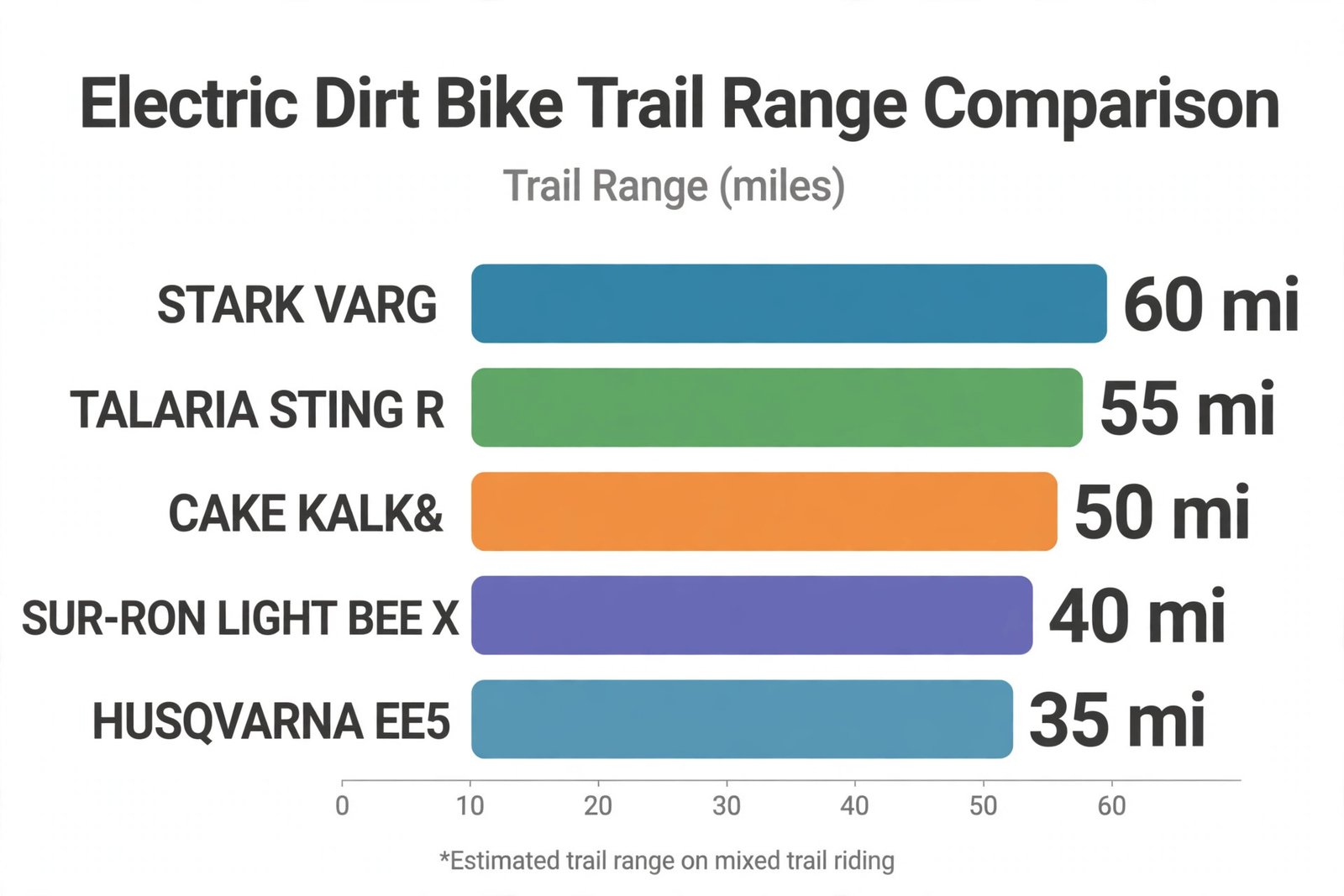

The best electric dirt bike for trail riding is the one that disappears underneath you on singletrack: light enough to flick between trees, quiet enough not to spook wildlife or annoy other trail users, with enough range to finish the loop and suspension that soaks up roots instead of kicking you off line. For most trail riders in 2026, that bike is the Surron Light Bee X — the lightest full-size e-moto you can buy — with the Talaria Sting R MX4 close behind for longer rides, the E Ride Pro SS 3.0 for fast open trails, the Rawrr Mantis X for budget trail riding, and the Stark Varg for riders who want full-size motocross performance with electric delivery. This guide ranks them for real trail work, explains what actually matters on singletrack versus fire roads, and covers the trail-specific setup — tyres, gearing, suspension and range management — that makes the difference between a great ride and a long walk home.
What makes a great trail bike (and why it is not top speed)
Trail riding is a different job from motocross or street riding, and the spec sheet that wins a drag race loses on singletrack. Four things decide trail performance.
Weight is king. On a tight trail you are constantly changing direction, dabbing a foot, lifting the front wheel over a log and catching the bike when it steps out. Every pound you carry is a pound you fight. A 123 lb Light Bee X and a 195 lb Ultra Bee feel like different sports in the woods, even though the heavier bike is faster in a straight line. For singletrack, lighter is almost always better.
Low-speed control beats peak power. Trails are ridden at 5–25 mph, not 50 mph. What matters is how smoothly the bike delivers power at walking pace, how precisely you can modulate the throttle over a root, and whether the bike creeps or lurches. A bike with good low-speed throttle mapping and a usable Eco mode will be faster through the woods than a more powerful bike with an on/off throttle.
Range at trail pace, not at 15 mph. Manufacturers quote range at slow, steady speeds on flat ground. Real trail riding — constant acceleration, braking, climbs, mud — uses far more energy. A bike that claims 75 miles may give you 30 on a technical trail. Plan your rides on real-world trail range, not the brochure number, and always keep a reserve.
Suspension that works at trail speed. Trail suspension needs to absorb small, sharp hits (roots, rocks) at low speed without deflecting, and soak up bigger hits (drops, ruts) without bottoming. Stock suspension on budget e-motos is often set up too stiff or too soft for an average adult, and it is the single most common upgrade trail riders make.
The trail shortlist at a glance
| Bike | Price (Nov 2026) | Weight | Battery | Real trail range* | Top speed | Best trail use |
|---|---|---|---|---|---|---|
| Surron Light Bee X | $4,000–$4,599 | 123–126 lb | 60V 40Ah (2,400 Wh) | 25–35 mi | 46–47 mph | Singletrack, all-round |
| Talaria Sting R MX4 | $3,799–$4,500 | 145–150 lb | 60V 45Ah (2,700 Wh) | 35–50 mi | 50–55 mph | Long trail loops |
| E Ride Pro SS 3.0 | $4,499–$4,999 | 167 lb | 72V 50Ah (3,600 Wh) | 40–60 mi | 62 mph | Fast open trails |
| Rawrr Mantis X | $2,999 | 139 lb | 72V 30Ah (2,160 Wh) | 25–35 mi | 50 mph | Budget trails |
| 79Bike Falcon M | $3,200–$3,500 | ~130 lb | 72V 35Ah (2,520 Wh) | 30–45 mi | ~50 mph | Lightweight value |
| Surron Ultra Bee | ~$6,499 | ~195 lb | 74V 55Ah (4,070 Wh) | 40–55 mi | 56–59 mph | Big, fast trails |
| Stark Varg | $11,990 | ~260 lb | 6.5 kWh | 40–60 mi | ~80 mph | Full-size MX trails |
| Talaria Sting MX5 Pro | ~$4,990 | ~163 lb | 72V 40Ah (2,880 Wh) | 35–50 mi | ~60 mph | Power + range |
*Real trail range is an estimate based on owner reports and dealer guidance — terrain, rider weight, temperature and mode change it by 30% or more. Treat these as planning figures, not guarantees.
1. Surron Light Bee X — the best trail bike for most riders
The Light Bee X is the best trail bike for most riders because it is the lightest full-size e-moto, and on trails, light wins. At 123–126 lb it changes direction with a thought, lifts over obstacles easily, and — critically — you can pick it up alone when you drop it in a rut, which every trail rider does regularly. Its 19-inch front and 18-inch rear wheels are the right size for trail work, its 32.7 in seat lets most adults flat-foot at a stop, and its Eco mode gives you the gentle throttle response that technical trails demand.
The range is the honest limitation: a 2,400 Wh battery gives roughly 25–35 miles of real trail riding, less in mud or hills. For a two-hour singletrack session that is plenty. For an all-day ride, it is not — you will need to plan a midday charge, carry a spare battery (the pack is removable and weighs about 25 lb), or pick a longer-range bike. The stock suspension is also the known weak point: the fork is crude and the rear shock is undersprung for heavier riders. Most serious trail riders budget $400–$800 for suspension work within the first year, and the huge Surron aftermarket makes that easy.
What the Light Bee X does better than anything else on this list is disappear. It is quiet, narrow, light and simple. On a trail, that means you ride the trail, not the bike. It is the bike experienced trail riders recommend to their friends, and the bike they keep even after buying something more powerful.
2. Talaria Sting R MX4 — the best trail bike for long loops
The MX4’s case for trail riding is range and refinement. Its 2,700 Wh battery is 12% bigger than the Surron’s, and its gearbox makes the motor more efficient at trail speeds — together, that means roughly 35–50 miles of real trail range, enough for a long loop without range anxiety. The gearbox also gives the MX4 a distinctive feel: quiet, smooth, almost turbine-like, with strong regenerative braking that helps on long descents and genuinely extends range on hilly terrain.
The trade is weight: 145–150 lb is about 20 lb more than the Light Bee X, and on tight, technical singletrack you feel every pound of it — in direction changes, in lifting the front wheel, and in picking the bike up. The MX4 is also more complex: the gearbox needs oil changes (Talaria recommends a first service at 300 km and regular changes after), and there are more parts that can wear. For a rider who does long trail days and values range over flickability, that is a fair trade. For a rider who lives on tight woods trails, it is not.
The MX4’s seat height matches the Light Bee X at 32.7 in, and its ergonomics suit taller riders well. Its stock suspension is generally regarded as better than the Surron’s out of the box, which narrows the effective price gap once you account for the suspension work a Light Bee X usually needs.
3. E Ride Pro SS 3.0 — the best trail bike for fast, open terrain
The SS 3.0 is the fastest bike on this list by a wide margin — 62 mph, 15.8 kW peak, 0–30 mph in about 2 seconds — and on fast, open trails (desert, fire roads, wide two-track) it is untouchable. Its 3,600 Wh battery is the biggest here, giving 40–60 miles of real trail range, and its belt drive is quieter and lower-maintenance than a chain, which matters when you are riding all day.
But the SS 3.0 is a poor singletrack bike. At 167 lb it is the heaviest bike in the sub-$5,000 class, and its power is far more than tight trails need — in the woods, you will spend the whole ride managing the throttle instead of riding the trail. Its size and weight also make it harder to manoeuvre at walking pace and harder to recover when it steps out. Buy the SS 3.0 if your trails are fast and open; buy the Light Bee X if they are tight and technical.
4. Rawrr Mantis X — the best budget trail bike
The Mantis X brings genuine 72V trail performance for $2,999: a swappable 2,160 Wh battery, 6,500 W peak, 50 mph, and a 139 lb chassis. On the trail it feels like a slightly taller, slightly heavier Light Bee X with more voltage and a better brake setup (four-piston hydraulics). Its Eco/Sport/Race modes give you the same graduated learning curve, and its phone-tunable controller lets you soften the throttle response for technical riding — a genuinely useful feature for trail work.
The compromises are the 34-inch seat (tall for shorter riders, though some owners measure it closer to 32 in), the thinner dealer network, and the smaller battery: 25–35 miles of real trail range, similar to the Light Bee X. The Mantis X is also the newest brand here, so long-term parts availability is less proven than Surron or Talaria. For a budget trail rider who does two-hour sessions and does their own maintenance, it is excellent value.
5. 79Bike Falcon M — the lightweight dark horse
The Falcon M deserves a mention because it combines the two things trail riders want most: low weight (about 130 lb) and a big battery (2,520 Wh, 72V). At $3,200–$3,500 it undercuts the Light Bee X on price while offering more range. Its 19-inch wheels and Surron-compatible parts help with spares. The problem is availability: by late 2026 the Falcon M was hard to find new, with 79Bike’s store pushing the Falcon Pro ($3,799) instead. If you find an M in stock with warranty support, it is a strong trail pick; if not, do not chase it — the Light Bee X and Mantis X are available now.
6. Surron Ultra Bee — the big trail bike
The Ultra Bee is what you buy when the Light Bee X feels too small: a 74V 55Ah battery (about 4,070 Wh), 12.5 kW peak (24.5 kW in the HP version), a 35.8 in seat, 19-inch wheels front and rear, and a claimed top speed of 56–59 mph. At about 195 lb it is a substantially bigger, heavier machine — closer to a full-size motocross bike than a trail toy — and it needs that size to carry its bigger battery and motor.
On big, fast trails the Ultra Bee is superb: stable at speed, powerful on climbs, and with 40–55 miles of real trail range. On tight singletrack it is work: the weight and the tall seat make it tiring, and the power is far more than the trail needs. It is also about $6,499, which puts it outside the budget of most trail riders. Buy it if you are a bigger rider, you ride fast open terrain, and you have outgrown the Light Bee X. Otherwise, the Light Bee X is the better trail tool.
7. Stark Varg — the full-size electric motocross bike
The Stark Varg is in a different league: 80 hp (60 kW), a 6.5 kWh battery, about 260 lb, and a $11,990 price tag. It is a full-size motocross bike that happens to be electric, with adjustable power from 10 hp to 80 hp via a phone app — which means you can detune it to trail-bike levels and then turn it up for the track. Its suspension, brakes and chassis are proper motocross hardware, not adapted e-bike parts.
For trail riding specifically, the Varg is overkill for almost everyone: it is heavy, expensive, and its range on trails (40–60 miles) is not dramatically better than the SS 3.0’s despite costing more than twice as much. But if you want one bike that does trails, track days and motocross, and you have the budget, nothing else on this list competes. It is the only bike here that a professional motocross rider would take seriously as a race bike.
8. Talaria Sting MX5 Pro — the power upgrade
The MX5 Pro is Talaria’s 72V flagship: 13.4 kW peak, a 72V 40Ah battery (2,880 Wh), about 60 mph, and 163 lb, at about $4,990. For trail riding it sits between the MX4 and the SS 3.0: more power and more voltage than the MX4, but heavier, and with the same gearbox refinement. It is a good bike, but for most trail riders the MX4 is the better value — the MX5’s extra power is rarely usable on a trail, and the extra weight is always noticeable.
Singletrack vs fire roads vs desert: matching the bike to the terrain
Tight singletrack (woods, technical trails): Light Bee X first, Falcon M second, Mantis X third. Weight and low-speed control matter most; range matters least because loops are short. Set the bike to Eco or a soft Sport mode, fit a trials-style rear tyre if your trails are rocky or rooty, and drop tyre pressures slightly (see below).
Flowing two-track and fire roads: MX4 or SS 3.0. Speeds are higher, loops are longer, and range starts to matter. The MX4’s gearbox and range win on hilly fire roads; the SS 3.0’s power wins on flat, fast ones.
Desert and open terrain: SS 3.0 or Ultra Bee. Long distances, high speeds, sand and whoops reward power, range and stability. Carry water, carry a spare tube, and tell someone your route — desert trail riding is the least forgiving kind.
Mixed riding (a bit of everything): Light Bee X. It is the only bike here that is genuinely good at all three, even if it is not the best at any one of them.
Trail setup: tyres, pressures, gearing and suspension
Tyres are the highest-value trail upgrade. The stock tyres on most e-motos are a compromise. For trail riding, the most popular choices are a soft-to-intermediate knobby up front for steering grip and a trials-style or soft-terrain tyre at the rear for traction on roots and rocks. The Light Bee X runs 70/100-19 front and 3.00-18 rear (older 60V models run 70/100-19 front and rear — check your sidewall). Our tyre guide for the Light Bee X (this build, planned) covers specific models and sizes in detail.
Tyre pressure matters more than tyre brand. For trail riding, most riders run 10–14 psi, versus 15–18 psi for road or hardpack. Lower pressure gives more grip and a softer ride over roots, but increases the risk of pinch flats and rim damage. Start at 12 psi front and rear, and adjust by feel. Carry a pump and a spare tube — a flat ten miles into a trail is a long walk.
Gearing changes the bike’s character. A larger rear sprocket (for example, 52T or 54T versus the stock 48T on a Light Bee X) gives more low-speed torque and a lower top speed — exactly what technical trails want. It is a cheap, reversible change, and it transforms the bike in the woods. The trade-off is less top speed on fire roads and slightly reduced range at high speed.
Suspension setup is free and transformative. Before spending money on upgrades, set sag correctly: with you sitting on the bike in riding gear, the suspension should compress about 25–30% of its travel. Most stock e-motos are set up for a lighter rider than you, or for no rider at all. A few clicks of compression and rebound damping, adjusted for your weight and terrain, can make a stock bike feel like a different machine. Our maintenance guide covers the basics; a suspension specialist can do a full setup for $100–$200.
Range management on the trail
Range anxiety ruins trail rides. Manage it properly and it disappears.
Know your real range. Do a test loop: fully charge, ride a known trail at your normal pace, note the distance and the battery percentage used. That gives you a personal miles-per-percent figure that is worth more than any manufacturer claim. Repeat it in different conditions — cold weather can cut range by 20% or more.
Ride smoothly. The single biggest range factor is your right hand. Smooth, steady throttle uses far less energy than stabbing the throttle out of every corner. Use Eco mode on climbs and flat sections, save Sport for the fun parts. Regenerative braking helps on descents — on the Talaria especially, use it.
Carry a plan, not just a battery. Know where the trail exits are, carry a phone with offline maps, and set a turn-around battery percentage (typically 30–40% remaining) rather than a turn-around time. If you ride with a group, agree the plan before you start — the rider with the smallest battery sets the route.
Cold weather. Lithium batteries lose capacity in the cold. In winter, store and charge the battery indoors, and expect 15–25% less range on a cold morning. Warm the battery by riding gently for the first ten minutes rather than hammering it from cold.
Trail etiquette and access
Electric dirt bikes are quiet, which is both a blessing and a responsibility. Other trail users — hikers, horse riders, mountain bikers — may not hear you coming. Slow down at blind corners, give way to non-motorised users, and never ride a trail that is not open to motorised vehicles. Trail access for e-motos is a privilege that is easily lost: one complaint about a rider tearing up a hiking trail can close an area to everyone.
Check before you ride: is the trail open to motorised use? Is there a permit or day fee? Are there seasonal closures? Your local off-road club or land manager will have the answers, and joining a club is the fastest way to learn the legal trails in your area. Riding on private land requires the landowner’s permission — always.
Noise is not the only impact. Electric bikes still erode trails, especially in wet conditions. Avoid riding muddy trails when you can — it damages the trail surface and your bike — and stay on the marked route rather than cutting new lines around obstacles.
Trail gear: what to carry
A trail ride is not a track day. Carry: a spare tube and tyre levers, a small pump or CO2 inflator, a multi-tool, a master link and a few zip ties, water, a charged phone, and a basic first-aid kit. A backpack with a hydration bladder is the standard trail setup. For longer rides, add a spare battery (if your bike’s pack is removable and you can carry the 25 lb), a tow strap, and a paper map as backup.
Wear the gear every ride: helmet, goggles, gloves, boots, knee guards, chest protector. Trail crashes happen at low speed but into hard objects — trees, rocks, roots — and the injuries are the same as at high speed.
Verdict: which trail bike should you buy?
For most trail riders, buy the Surron Light Bee X. It is the lightest, the most agile, the best supported, and the easiest to live with on singletrack. If your rides are long and range matters more than flickability, buy the Talaria Sting R MX4. If your trails are fast and open and you want the most power under $5,000, buy the E Ride Pro SS 3.0. If your budget is tight, buy the Rawrr Mantis X and spend the savings on tyres and suspension setup. And if money is no object and you want the best electric trail bike that exists, buy the Stark Varg — then detune it to 30 hp and enjoy the best-handling e-moto ever made.
Frequently asked questions
What is the best electric dirt bike for trail riding?
The Surron Light Bee X is the best electric dirt bike for trail riding for most riders: at 123–126 lb it is the lightest full-size e-moto, with good low-speed control, a 32.7 in seat and the deepest parts support. The Talaria Sting R MX4 is better for long trail loops thanks to its bigger battery and gearbox.
How far can an electric dirt bike go on trails?
Real trail range is roughly 25–35 miles for a Surron Light Bee X, 35–50 miles for a Talaria Sting R MX4, and 40–60 miles for an E Ride Pro SS 3.0. Manufacturer claims are higher because they are measured at slow steady speeds on flat ground. Terrain, rider weight, temperature and throttle use can change range by 30% or more.
Are electric dirt bikes good for singletrack?
Yes — they are arguably better than petrol bikes for singletrack. They are quiet, light, have instant low-speed torque with no clutch to manage, and produce no exhaust fumes in the woods. The main limitation is range on long loops, and the need to plan charging.
What tyre pressure should I run on trails?
Most trail riders run 10–14 psi, versus 15–18 psi for hardpack or road use. Start at 12 psi front and rear and adjust by feel. Lower pressure gives more grip on roots and rocks but increases pinch-flat risk. Always carry a pump and a spare tube.
Should I change the sprocket for trail riding?
A larger rear sprocket (52T or 54T versus the stock 48T on a Light Bee X) gives more low-speed torque for technical trails and is a cheap, reversible upgrade. It reduces top speed, which rarely matters on a trail. It is one of the best value trail modifications you can make.
Is the Talaria Sting R better than the Surron Light Bee X for trails?
For long trail loops, yes — the MX4’s bigger battery and gearbox give it more range and a smoother feel. For tight, technical singletrack, no — the Light Bee X is about 20 lb lighter and easier to manoeuvre and pick up. Choose by your terrain: long loops favour the Talaria, tight woods favour the Surron.
Can you ride an electric dirt bike on public trails?
Only on trails that are open to motorised vehicles. Rules vary by state and by land manager — national forests, state parks and private land all have different rules. Check with the local land manager or off-road club before riding, and never assume a hiking or mountain-bike trail is open to motorised use.
How do I make my electric dirt bike go further on trails?
Ride smoothly, use Eco mode on climbs and flat sections, keep tyres at the right pressure, keep the chain clean and lubed, and avoid carrying unnecessary weight. Cold weather cuts range by 15–25%, so store and charge the battery indoors in winter. A larger rear sprocket helps low-speed efficiency on technical trails.
What is the lightest electric dirt bike for trail riding?
The Surron Light Bee X is the lightest full-size adult e-moto at 123–126 lb ready to ride. The Surron Hyper Bee is lighter (86 lb) but is a smaller bike built for younger and smaller riders, with 14/12-inch wheels that are less capable on rough trails.
Do electric dirt bikes need different suspension for trails?
Most stock e-moto suspension is a compromise. Setting sag correctly for your weight is free and makes the biggest difference. After that, a re-valve or spring change ($200–$500) tailored to your weight and terrain is the most effective trail upgrade, ahead of power or battery modifications.
Related guides
- Best Electric Dirt Bikes for Beginner Adults (2026) — the beginner shortlist (this build)
- Best Electric Dirt Bikes Under $5000 (2026) — the full under-$5,000 comparison (this build, planned)
- Best Tires for Surron Light Bee X — trail, street and supermoto tyres (this build, planned)
- How to Ride an Electric Dirt Bike for Beginners — trail technique (this build, planned)
- Electric Dirt Bike Maintenance Guide — suspension setup and servicing (live on PumpFlow)
- Surron Light Bee X review — the deep dive (live on PumpFlow)
Prices and specifications checked against manufacturer and US dealer listings, November 2026. Range figures are planning estimates, not guarantees — your range will vary with terrain, weight, temperature and riding style.