The best tires for Surron Light Bee X depend on where you ride: a soft-terrain knobby for muddy trails, an intermediate knobby for mixed dirt, a trials-style rear for rocks and roots, a street tyre for road use, or a supermoto setup for tarmac. The stock CST knobbies are adequate for learning but they are a compromise — the single highest-value upgrade on a Light Bee X is a set of tyres matched to your terrain, and it costs less than a suspension upgrade while making a bigger difference to grip. This guide gives you the correct sizes by model year, the best tyre for each use, pressures, tubes, fitting tips and the mistakes that waste money.
First: what size tires does a Surron Light Bee X take?
This is the question that causes the most wrong orders, because the answer changed by model year — and because a lot of online guides quote the wrong size.
Current 2026 (72V) Light Bee X and most 60V models: 70/100-19 front, 3.00-18 rear, on 19-inch front and 18-inch rear wheels. Several dealer listings and the Surron owner’s manual confirm 70/100-19 front and 3.00-18 rear for the current bike.
Older 60V models (2019–2023): many were listed as 70/100-19 front and rear, on 19-inch wheels front and rear. Some dealer spec sheets still show this. The difference is real — Surron changed the rear wheel from 19-inch to 18-inch at some point in the model’s life, and the change is not consistently documented.
The rule that overrides everything: read the size moulded into the sidewall of the tyre that is on your bike right now. That is the definitive answer for your bike, your year, and your market. Do not order by model year, do not order by what a forum post says, and do not assume your bike matches your friend’s bike. Check the sidewall, write the size down, and order that size.
The Ultra Bee is different: it runs 80/100-19 front and 90/90-19 (or 100/90-18, depending on source) rear on twin 19-inch wheels. Do not order Light Bee X tyres for an Ultra Bee, or vice versa.
Understanding the size code: 70/100-19 means the tyre is 70 mm wide, its sidewall height is 100% of its width (so 70 mm tall), and it fits a 19-inch rim. 3.00-18 is an older inch-based size meaning 3.00 inches wide on an 18-inch rim — roughly equivalent to 80/100-18 in metric terms. When you see both systems used for the same bike, that is why.
How to read a tire: tread patterns explained
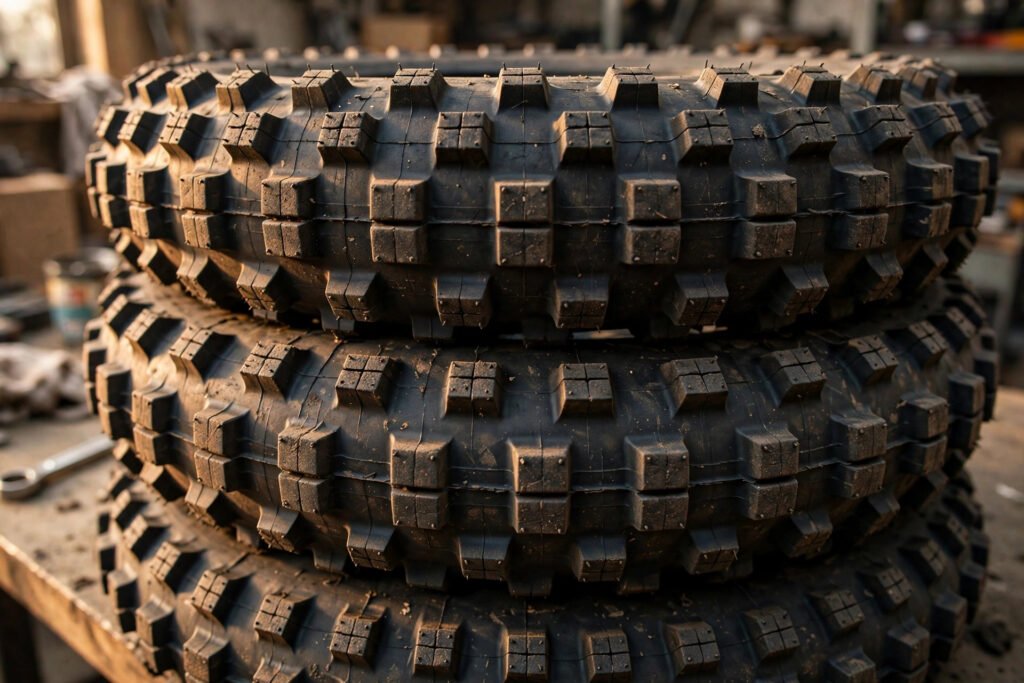
Knobby (motocross-style). Tall, widely spaced blocks that dig into soft dirt and shed mud. Best for: loose dirt, mud, sand, and general trail riding. Weakness: poor grip and fast wear on hard surfaces and tarmac.
Intermediate knobby. Shorter, closer-spaced blocks that work on a mix of hardpack and soft dirt. Best for: riders who ride varied terrain and want one tyre to do everything. Weakness: not the best in deep mud, not the best on rock.
Trials-style. Very soft compound, dense tread, designed for grip on rock, roots and hard surfaces at low speed. Best for: technical trails, rocks, roots, and slow-speed control. Weakness: wears quickly at speed and on tarmac; poor in deep mud.
Dual-sport / street knobby. A knobby pattern with a harder compound and a more continuous centre tread, designed to work on dirt and tarmac. Best for: riders who ride to the trail on the road, or who mix street and dirt. Weakness: a compromise — less grip than a proper knobby off-road, less grip than a proper street tyre on-road.
Supermoto (17-inch street). A full street tyre on a 17-inch wheel, for tarmac-only riding. Best for: street, supermoto tracks, and urban riding. Weakness: useless off-road — do not take supermoto tyres on a trail.
Paddle / sand tyre. Widely spaced scoops for sand. Best for: dunes and deep sand only. Weakness: terrible everywhere else. Most riders do not need one.
Best trail tires for the Light Bee X
For trail riding, the front and rear tyres do different jobs, and many experienced riders run different tyres front and rear. The front tyre steers and brakes; the rear tyre drives and needs traction. A common and effective combination is an intermediate knobby up front and a trials-style or soft-terrain tyre at the rear.
Best all-round trail tire: intermediate knobby
If you ride mixed terrain — hardpack, loose dirt, some mud, some rock — and you want one tyre to do everything, an intermediate knobby is the answer. Look for a tyre with medium-height blocks, a spacing that sheds mud without clogging, and a compound that is soft enough to grip but hard enough to last. In the 70/100-19 front size, the most commonly recommended intermediate options in the Surron community are the Dunlop Geomax MX33 (front) and the Michelin Starcross 5 Medium — both are proper motocross tyres that fit the Light Bee X’s 19-inch front wheel and are widely available. For the rear (3.00-18), the Dunlop Geomax MX33 and Michelin Starcross 5 Medium are again the go-to choices, with the Pirelli Scorpion MX32 Mid Soft as a strong alternative.
What to expect: noticeably better grip than the stock CST tyres in every condition, better braking, and better feel through the handlebars. Expect to pay $60–$100 per tyre, and expect a rear tyre to last 30–50 hours of trail riding (less in mud and sand, more on hardpack).
Best mud and soft-terrain tire
If your trails are muddy, sandy or soft, you need a soft-terrain knobby with tall, widely spaced blocks that dig in and shed mud. The Dunlop Geomax MX12 (sand/mud) and the Michelin Starcross 5 Soft are the standard picks. Run them at lower pressures (10–12 psi) to maximise the contact patch. Be aware that soft-terrain tyres wear quickly on hard surfaces — if you ride to the trail on tarmac, you will chew through a soft tyre in a few rides.
Best technical trail tire: trials-style rear
For rocky, rooty, technical trails ridden at low speed, a trials-style rear tyre is transformative. Trials tyres use a very soft compound and a dense, flexible tread that conforms to rock and root surfaces, giving grip where a knobby would skate. The Michelin Trial X Light and the Dunlop D803GP are the most commonly fitted trials tyres in the 18-inch rear size for the Light Bee X. Pair a trials rear with an intermediate knobby front — the front still needs to steer and brake, which a trials tyre does poorly at speed.
Trade-offs: trials tyres wear quickly at speed, overheat on long fast sections, and are poor in deep mud. They are a specialist tool for technical riding, not an all-rounder. If your trails are fast and open, stick with a knobby.
Best budget trail tire
If you want better than stock without spending $200 on a pair, look at the CST range (the same brand as the stock tyre, but in a more aggressive pattern), or the Kenda Washougal II and Kenda Millville II, which are well-regarded budget motocross tyres that fit the Light Bee X’s sizes. A pair of Kendas costs roughly $100–$140, versus $140–$200 for Dunlop or Michelin. The performance gap is real but small for a casual trail rider — the Kendas are a large step up from stock, and the money saved buys a spare tube and a tyre pump.
Best street tires for the Light Bee X
If you ride your Light Bee X on the road — to the trail, around private land with tarmac, or as a street-legal L1E — the stock knobbies are a liability. They vibrate, they wear quickly on tarmac, they grip poorly in the wet, and they are noisy. A street tyre transforms the bike on tarmac.
Dual-sport tyres are the compromise for riders who mix road and dirt: the Pirelli MT60RS and the Dunlop D605 are popular dual-sport options that fit the Light Bee X’s wheel sizes and give reasonable grip on both surfaces. They are the right choice if you ride 50/50 road and trail.
Full street tyres are for riders who are mostly on tarmac: the Michelin Pilot Street 2 and the Pirelli Diablo Rosso Scooter (in the appropriate sizes) are commonly fitted to Light Bee X wheels for street use. They give proper wet-weather grip, low rolling resistance (which extends range), and a much quieter, smoother ride. They are useless off-road — do not take them on a trail.
A note on legality: the off-road Light Bee X is not road-legal in most jurisdictions, and fitting street tyres does not make it legal. The road-legal L1E version is a different homologated model. Fitting street tyres to an off-road bike for use on private land or a track is fine; riding it on public roads is a separate legal question. Check your local rules — this is general information, not legal advice.
Best supermoto tires for the Light Bee X
Supermoto means 17-inch wheels and full street tyres, and it is the most fun you can have on tarmac on a Light Bee X. A supermoto conversion typically involves a 17-inch wheel set (front and rear), street tyres, and often a larger front brake disc. The wheel set is the expensive part ($500–$1,200 for a set, depending on brand); the tyres are the cheap part.
Tyre choices for supermoto: the Michelin Pilot Power 2CT and the Pirelli Diablo Rosso IV are the most popular supermoto tyres in 17-inch sizes, offering strong dry and wet grip and good feel at lean. The Dunlop Sportmax GPR-300 is a strong budget alternative. In supermoto sizes (typically 110/70-17 front and 140/70-17 rear, though exact fitment depends on your wheel set — check with the wheel manufacturer), expect to pay $120–$200 per pair.
Should you convert to supermoto? Only if you ride mostly on tarmac. A supermoto Light Bee X is a superb urban and track bike, but it cannot go off-road — the 17-inch wheels and street tyres have no grip on dirt, and the lower ground clearance makes trail obstacles a problem. Many riders keep two wheel sets (19/18-inch knobbies for trails, 17-inch supermoto for street) and swap them in 20 minutes. That is the best of both worlds, if you can afford the second set.
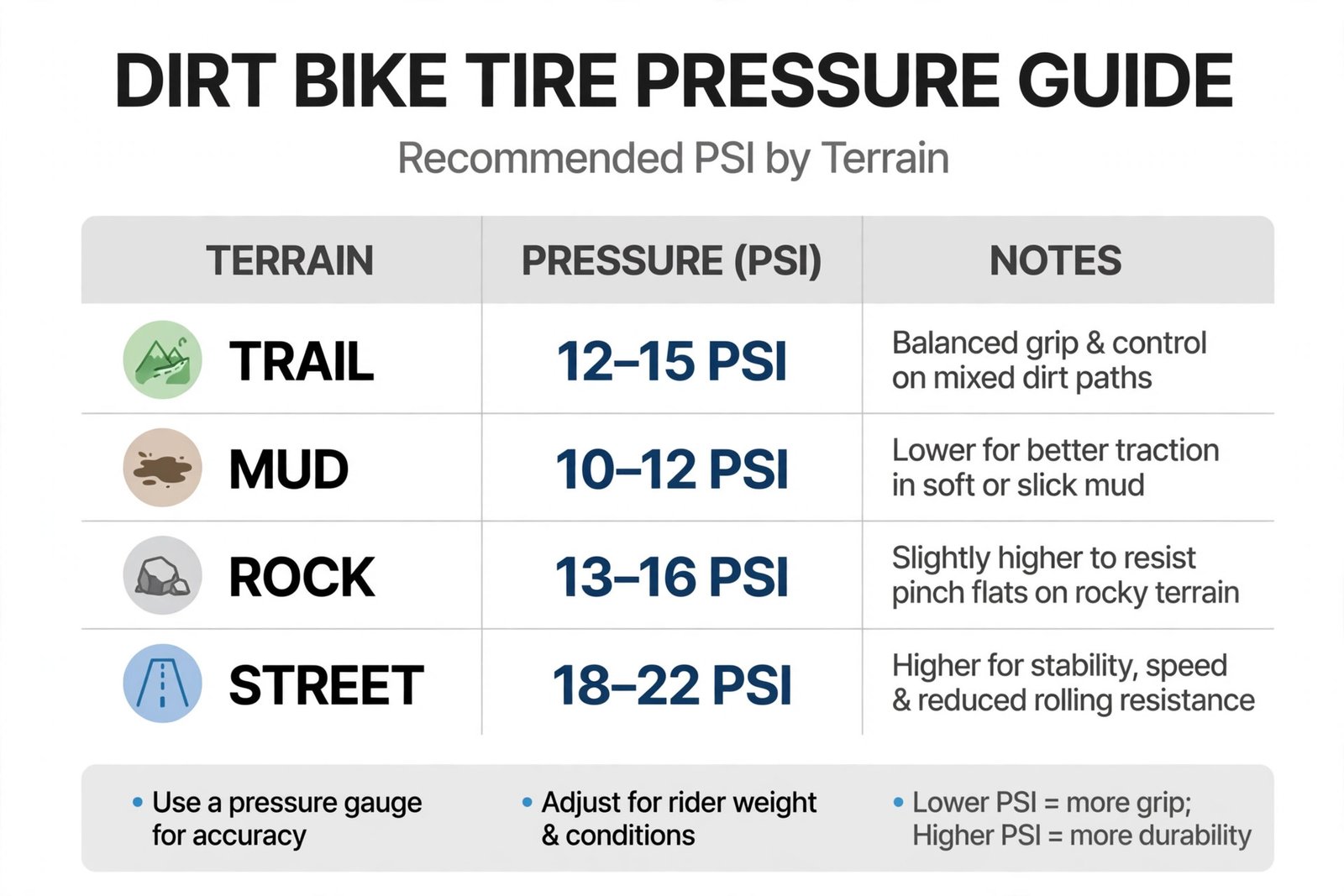
Tire pressure: the free upgrade
Tyre pressure matters more than tyre brand. The right pressure for your terrain and weight will do more for grip than spending $200 on premium tyres and running them at the wrong pressure.
| Terrain | Front pressure | Rear pressure | Notes |
|---|---|---|---|
| Trail (mixed dirt) | 12–14 psi | 12–14 psi | Start here; adjust by feel |
| Mud / soft terrain | 10–12 psi | 10–12 psi | More grip, higher pinch-flat risk |
| Rock / technical | 10–12 psi | 10–12 psi | Trials tyres can go lower (8–10 psi) with a heavy-duty tube |
| Hardpack / fire roads | 14–16 psi | 14–16 psi | Firmer for stability at speed |
| Street / tarmac | 18–22 psi | 20–24 psi | Check the tyre’s sidewall maximum |
| Supermoto | Per tyre maker’s spec | Per tyre maker’s spec | Usually 28–32 psi |
How to find your pressure: start at the table value, ride a familiar trail, and adjust by 1–2 psi at a time. If the bike feels vague and wallowy, add pressure. If it feels harsh and skittish over roots, remove pressure. Heavier riders need more pressure; lighter riders need less. Always check pressure when the tyres are cold, and re-check after the first ride — a new tyre can lose a few psi as it seats.
Pinch flats: the risk of running low pressure is a pinch flat — the tube gets pinched between the rim and a rock or root. Heavy-duty tubes, or a mousse (foam insert) for serious trail riders, reduce the risk. Carry a spare tube and a pump on every ride.
Tubes, rim locks and mousse
Tubes: match the tube to the tyre size. A 70/100-19 front tyre takes a 70/100-19 tube; a 3.00-18 rear takes a 3.00-18 (or 80/100-18) tube. Heavy-duty tubes are thicker and more resistant to pinch flats — worth the small extra cost for trail riding. Always carry a spare tube in the size for the wheel most likely to flat (usually the rear).
Rim locks: a rim lock is a small clamp that prevents the tyre from rotating on the rim under hard acceleration or braking. The Light Bee X’s stock setup may not have rim locks, and at low trail pressures (10–12 psi) the tyre can slip on the rim, tearing the valve stem out of the tube. If you run low pressures, fit rim locks — they are cheap ($10–$20 each) and they prevent the most common trail flat.
Mousse (foam insert): a mousse replaces the tube entirely with a foam ring that cannot puncture. It is the standard for enduro racing, and it is increasingly popular for trail riding. The downsides are cost ($100–$150 per wheel), a different feel (softer, less precise), and the need for regular lubrication and replacement. For a casual trail rider, heavy-duty tubes and rim locks are sufficient. For a rider who flats constantly, a mousse is worth considering.
How to change a Surron tire (overview)
Changing a tyre on a Light Bee X is a learnable skill, and it is worth learning — a flat ten miles into a trail is a long walk if you cannot fix it. The full step-by-step is a separate guide; the overview is:
- Remove the wheel (loosen the axle nut, support the bike on a stand, slide the axle out).
- Deflate the tyre fully and break the bead (push the tyre away from the rim all the way round).
- Use tyre levers to work one side of the tyre off the rim, then remove the tube.
- Inspect the inside of the tyre and the rim for the cause of the flat (a thorn, a pinch, a spoke).
- Fit the new tube with a little air in it (so it holds its shape), work the tyre back onto the rim, and inflate slowly, checking the bead seats evenly.
- Refit the wheel, torque the axle nut to the manual’s specification, and check the brake.
Tips: use proper tyre levers, not screwdrivers (which damage the rim and puncture the tube). Use a little soapy water on the bead to help it seat. Inflate in stages, and never exceed the tyre’s maximum pressure. Practise at home before you need to do it on a trail.
Tire wear: when to replace
Replace a tyre when: the knobs are worn to less than half their original height; the tyre is cracked, cut or has exposed cords; the tyre has a bulge or a flat spot; or the tyre is more than 3–4 years old (rubber hardens with age, even if the tread looks fine). A worn rear tyre is the most common cause of poor traction on a trail — if your bike is spinning up on climbs it used to manage, the tyre is probably the cause, not the motor.
How long do they last? A rear knobby lasts roughly 30–50 hours of trail riding; a front lasts roughly twice as long. Street tyres last 3,000–5,000 miles. Trials tyres last 20–40 hours. Your mileage will vary with terrain, throttle use and rider weight — a heavy rider who spins the rear wheel will wear a tyre in half the time of a smooth, light rider.
Common tire mistakes
Ordering the wrong size. Check the sidewall. Every time. The 19/19 vs 19/18 rear wheel difference has caused more wrong orders than any other single issue on this bike.
Running street pressures off-road. A tyre at 20 psi on a muddy trail has no grip. Drop the pressure for dirt, and pump it back up for the road.
Running trail pressures on the road. A knobby at 12 psi on tarmac will overheat, wear unevenly, and handle badly. Pump it up.
Ignoring the front tyre. Riders replace the rear tyre and forget the front. A worn front tyre is more dangerous than a worn rear — it is the tyre that steers and does most of the braking. Replace fronts when they are worn, not just when they are bald.
Mixing a new rear with a bald front (or vice versa). Mismatched grip front to rear makes the bike unpredictable. Replace tyres as a pair when both are worn, or at least keep the grip levels similar.
Forgetting the tube. A new tyre with an old, patched, wrong-size tube is a flat waiting to happen. Fit a new tube with a new tyre, and match the size.
Recommended setups by rider
The weekend trail rider (mixed terrain): Dunlop Geomax MX33 or Michelin Starcross 5 Medium front and rear, 12–14 psi, heavy-duty tubes, rim locks. Cost: roughly $140–$200 for the pair.
The technical trail rider (rocks, roots, slow speed): Intermediate knobby front, trials-style rear (Michelin Trial X Light), 10–12 psi, heavy-duty tubes. Cost: roughly $150–$220 for the pair.
The mud rider: Soft-terrain knobbies front and rear (Dunlop MX12 / Michelin Starcross 5 Soft), 10–12 psi. Cost: roughly $140–$200 for the pair.
The 50/50 road-and-trail rider: Dual-sport tyres (Pirelli MT60RS), 14–16 psi off-road and 20+ psi on-road. Cost: roughly $160–$220 for the pair.
The street / supermoto rider: 17-inch supermoto wheel set with Michelin Pilot Power 2CT or Pirelli Diablo Rosso IV, at the tyre maker’s recommended pressure. Cost: $500–$1,200 for wheels plus $120–$200 for tyres.
The budget rider: Kenda Washougal II or Millville II front and rear, 12–14 psi, standard tubes. Cost: roughly $100–$140 for the pair — a large step up from stock for the price of a tank of petrol (if your bike used petrol).
Frequently asked questions
What size tires does a Surron Light Bee X take?
The current Light Bee X takes a 70/100-19 front tyre and a 3.00-18 rear tyre, on 19-inch front and 18-inch rear wheels. Older 60V models were listed as 70/100-19 front and rear on 19-inch wheels. Always read the size moulded into your current tyre’s sidewall — that is the definitive answer for your bike and year.
What are the best tires for a Surron Light Bee X?
For trail riding, the Dunlop Geomax MX33 or Michelin Starcross 5 Medium (front and rear) are the best all-round choices. For technical rocky trails, pair an intermediate front with a trials-style rear (Michelin Trial X Light). For street use, a dual-sport tyre such as the Pirelli MT60RS, or a full supermoto conversion with 17-inch wheels.
Can I put street tires on a Surron Light Bee X?
Yes — dual-sport tyres fit the stock 19/18-inch wheels and work on road and dirt, while a full supermoto conversion uses 17-inch wheels and street tyres for tarmac-only riding. Fitting street tyres does not make an off-road Light Bee X road-legal; the road-legal version is the homologated L1E model.
What tire pressure should I run on my Surron?
For trail riding, 12–14 psi front and rear is the starting point; 10–12 psi for mud, rock or technical terrain; 14–16 psi for hardpack. For street use, 18–24 psi. Check pressure when the tyres are cold, and adjust by 1–2 psi at a time based on feel.
How long do Surron tires last?
A rear knobby lasts roughly 30–50 hours of trail riding; a front lasts about twice as long. Street tyres last 3,000–5,000 miles. Replace a tyre when the knobs are worn to less than half their original height, or when the rubber is cracked, cut or more than 3–4 years old.
Do I need rim locks on a Surron Light Bee X?
If you run low trail pressures (10–12 psi), yes — rim locks prevent the tyre from rotating on the rim and tearing the valve stem out of the tube. They cost $10–$20 each and are cheap insurance against the most common trail flat.
Can I use Talaria tires on a Surron Light Bee X?
Some sizes are shared — the Talaria Sting MX3/MX4 uses a 70/100-19 front, which matches the Light Bee X front — but the rear sizes differ (Talaria uses 80/100-19 rear on 19-inch wheels). Always match the tyre to your bike’s wheel size and the size on your current tyre’s sidewall, not to another brand’s spec sheet.
What is the best supermoto tire for a Surron?
The Michelin Pilot Power 2CT and Pirelli Diablo Rosso IV are the most popular supermoto tyres for the Light Bee X in 17-inch sizes, with the Dunlop Sportmax GPR-300 as a budget alternative. A supermoto conversion needs a 17-inch wheel set ($500–$1,200) as well as the tyres.
Are trials tires good on a Surron Light Bee X?
For technical, rocky, rooty trails at low speed, yes — a trials-style rear tyre gives dramatically better grip than a knobby on rock and roots. They wear quickly at speed and are poor in deep mud, so they are a specialist choice for technical riding, not an all-rounder. Pair with an intermediate knobby front.
How do I change a tire on a Surron Light Bee X?
Remove the wheel, deflate and break the bead, lever one side off the rim, remove the tube, inspect for the cause of the flat, fit a new tube with a little air in it, work the tyre back on, inflate slowly and check the bead seats evenly, then refit and torque the axle nut to the manual’s specification. Practise at home with proper tyre levers before you need to do it on a trail.
Related guides
- Best Electric Dirt Bikes for Trail Riding (2026) — trail bike picks and setup (this build)
- How to Change a Surron Tire — the full step-by-step (planned, other batch)
- Electric Dirt Bike Maintenance Guide — the full service checklist (live on PumpFlow)
- Best Surron Brake Upgrades — stopping power to match your new grip (planned, other batch)
- Surron Light Bee X review — the deep dive (live on PumpFlow)
Tyre sizes and prices checked against manufacturer and US dealer listings, November 2026. Always confirm the size on your own tyre’s sidewall before ordering — sizes vary by model year and market.