The electric dirt bike battery guide every new rider needs starts with one plain fact: the battery is the most expensive part of your bike, the part that decides how far you ride, and the part that punishes bad habits the fastest. A well-looked-after pack gives years of honest range; a pack charged on the wrong charger, ridden flat every weekend, stored dead all winter, or charged freezing cold can lose a big chunk of its capacity in a single season — and a replacement costs about $850 to $3,500. Almost all of that damage is preventable.
This guide covers it all, rider to rider, in plain English: what a battery is and how to read its numbers; specs for every major bike in 2026; real-world range; health checks; charging, storage and daily care; what to do when a battery is damaged; and when and how to replace it, including what to check on a used bike before you pay.
Safety first: Never open a battery pack, never bypass the BMS, and never charge a swollen, hot, smelly or crash-damaged pack. If a pack looks or smells wrong, stop riding, do not charge it, and contact a dealer — there are no user-serviceable parts inside.
What Is an Electric Dirt Bike Battery?
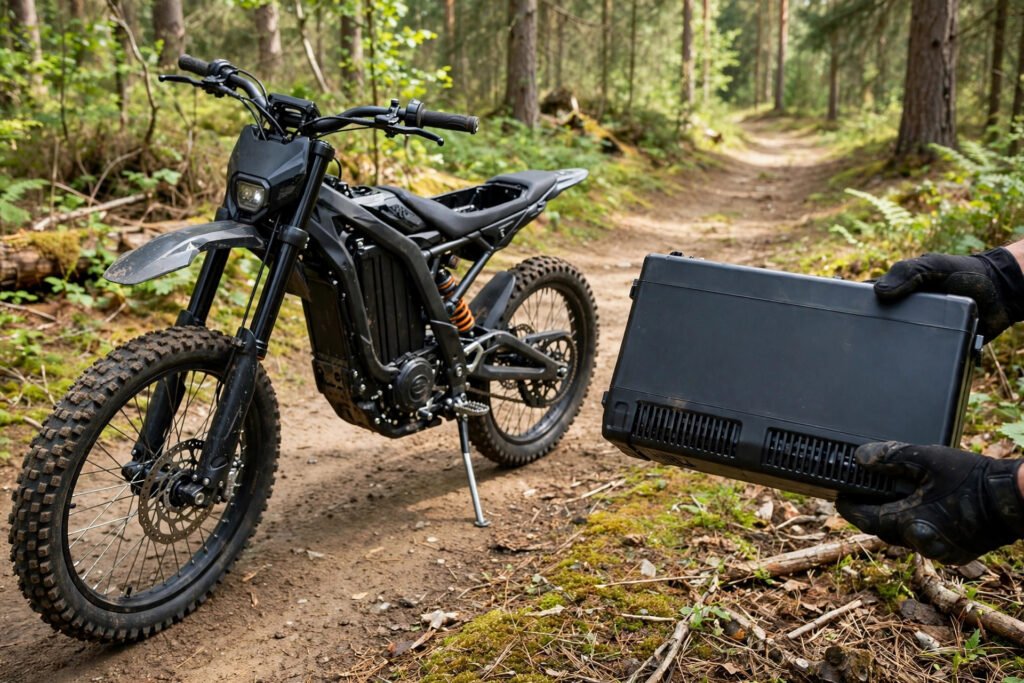
An electric dirt bike battery is a sealed pack of lithium-ion cells, managed by a small computer called a Battery Management System (BMS), in a tough case that slides into the bike’s frame. It is dozens of cells wired together in groups, and the BMS watches every group — balancing charge between them, cutting power if a group gets too low or too hot, and refusing to charge if the pack is too cold, too low, or damaged.
Voltage (V): the push
Voltage is the electrical pressure that pushes power to the motor. Higher voltage generally means more power — entry-level bikes run at 60V, performance bikes at 72V or 74V. Voltage also decides charger compatibility: a 60V charger will not properly charge a 72V pack, and a 72V charger on a 60V pack is dangerous. Never mix them — check the label every time.
Amp-hours (Ah): the size of the tank
Amp-hours measure how much charge the pack holds — the size of the fuel tank. A 40Ah pack holds more energy than a 32Ah pack at the same voltage, but Ah alone does not compare bikes at different voltages: a 40Ah pack at 60V holds less energy than a 40Ah pack at 72V.
Watt-hours (Wh): the number that lets you compare anything
Watt-hours combine voltage and capacity into one measure of total energy:
Wh = V × Ah
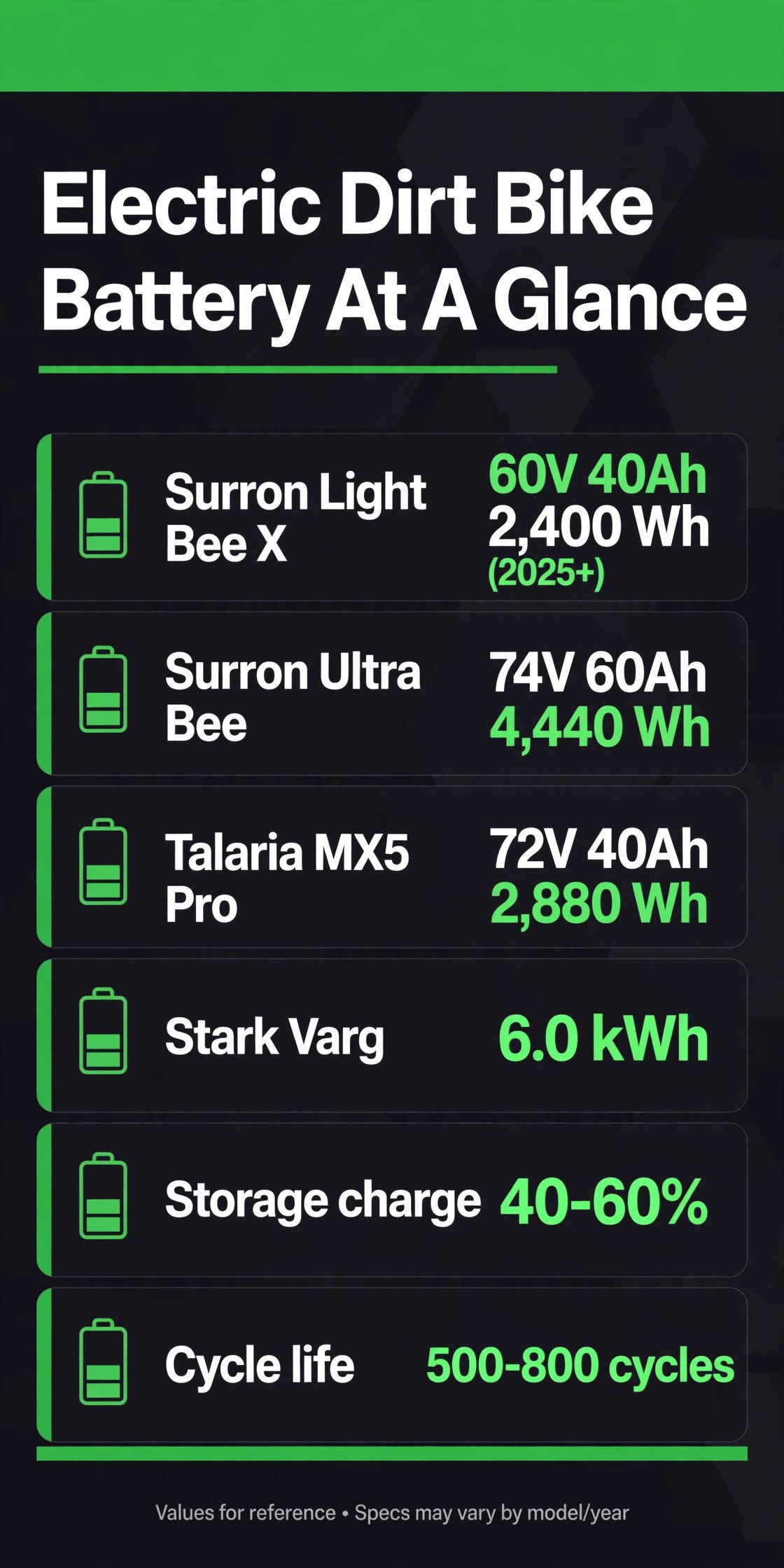
Worked example: a Surron Light Bee X 2025 pack is rated 60V and 40Ah. Multiply them: 60 × 40 = 2,400 Wh, or 2.4 kWh — the same unit your electricity bill uses. A full charge from flat uses roughly 2.4–2.7 kWh from the wall, which at typical US residential rates of $0.15–$0.20 per kWh costs about $0.40–$0.55. For the full cost breakdown, see how much it costs to charge a Surron.
A bigger Wh number usually means more range — but not in direct proportion, because a heavier, more powerful bike burns energy faster.
What is a BMS, and why does it matter?
The BMS (Battery Management System) is the pack’s built-in guardian: it balances the cell groups, cuts power if a group drops too low or the pack gets too hot, refuses to charge if the pack is too cold, too hot or too low, and shuts the pack into low-power sleep when it sits unused. You cannot service, repair or bypass a BMS yourself — if the BMS is the problem, it is a dealer-only job.
Cell types: what is inside the pack
Battery Specs by Model (2026)
All prices are November 2026 snapshots — treat them as a guide, not a quote.
| Bike | Battery | Energy | Price (Nov 2026) |
|---|---|---|---|
| Surron Light Bee X (pre-2025) | 60V 32Ah | 1,920 Wh | $4,299–$5,100 |
| Surron Light Bee X (2025+) | 60V 40Ah | 2,400 Wh | $4,299–$5,100 |
| Surron Ultra Bee | 74V 60Ah | ~4,440 Wh | $5,999–$6,399 |
| Talaria Sting MX3 | 60V 38.4Ah | ~2,304 Wh | Varies |
| Talaria Sting R MX4 | 60V 45Ah | 2,700 Wh | Varies |
| Talaria Sting MX5 Pro | 72V 40Ah | 2,880 Wh | Varies |
| E Ride Pro SS 2.0 | 72V 40Ah | 2,880 Wh | $4,699–$5,799 |
| E Ride Pro SS 3.0 | 72V 50Ah | 3,600 Wh | $4,699–$5,799 |
| E Ride Pro SS 4.0 | 72V (3,600 Wh) | 3,600 Wh | ~$4,999 |
| Stark Varg | 6.0 kWh | 6,000 Wh | $11,990–$13,490 |
| Stark Varg EX | 7.2 kWh | 7,200 Wh | $12,990–$13,040 MSRP range |
Surron Light Bee X — the model-year split you must know
The Light Bee X is the best-selling electric dirt bike in the world, and the one with the most confusing battery spec. Pre-2025 bikes shipped with a 60V 32Ah pack (1,920 Wh); 2025+ models ship with a 60V 40Ah pack (2,400 Wh), a 25% increase — but sources still conflict on when the change rolled out in each market, so if you are buying used, check the label on the actual pack. The bike is usually $4,299–$5,100, MSRP around $4,400–$4,499. For Surron health checks, see how to check Surron battery health.
Surron Ultra Bee — the big step up
The Ultra Bee runs a 74V 60Ah pack — about 4,440 Wh, nearly double a 2025 Light Bee X — with 24.5 kW of peak power. Prices in November 2026 run $5,999–$6,399 by dealer, and the pack is heavier and more expensive to replace than a Light Bee pack.
Talaria Sting MX3, MX4 and MX5 Pro — three voltages, three chargers
The MX3 runs a 60V 38.4Ah pack (~2,304 Wh), the MX4 (Sting R) steps up to 60V 45Ah (2,700 Wh) with LG cells, and the MX5 Pro jumps to 72V 40Ah (2,880 Wh) with Samsung 50S cells and roughly 13.5 kW peak. Critical point: the MX3 and MX4 use 60V chargers and the MX5 Pro uses a 72V charger — not interchangeable, and the wrong one is dangerous. For charging steps, see how to charge a Talaria Sting; for charging failures, see Talaria battery not charging.
E Ride Pro SS — versions differ, check before you buy
The SS 2.0 runs a 72V 40Ah pack (2,880 Wh) with 12 kW peak; the SS 3.0 steps up to a 72V 50Ah pack (3,600 Wh) with 15.8 kW peak; and the SS 4.0 keeps the 3,600 Wh pack and pushes peak power to 18 kW, priced around $4,999. Across the range, prices run $4,699–$5,799 by version and dealer — so ask which version, check the pack label, and price the bike against the version it actually is.
Stark Varg — the outlier
The standard Varg pack holds 6.0 kWh (6,000 Wh) and feeds a 60 kW (80 hp) motor — more power than most 450cc petrol motocross bikes — while the Varg EX carries a larger 7.2 kWh pack. Prices run $11,990–$13,490, MSRP $12,990–$13,040 by version and market, and the Varg’s battery is the most expensive to replace here, at roughly $3,499 for a 6.5 kWh pack.
Range, Honestly: Claimed vs Real-World Miles
Range is where brochure numbers and real riding diverge most. Manufacturers quote figures measured in gentle conditions — a light rider, flat ground, warm weather, the lowest power mode, a steady moderate speed. Almost nobody rides like that. Honest rule of thumb: real-world trail range is typically 50–70% of the claimed maximum.
Real-world range table
Realistic ranges for mixed trail riding with an average adult rider. Treat them as ranges, not promises.
| Bike | Claimed range | Real-world trail range |
|---|---|---|
| Surron Light Bee X (2025+) | ~60 miles | ~30–45 miles |
| Surron Light Bee X (pre-2025) | ~50 miles | ~25–35 miles |
| Surron Ultra Bee | ~87 miles | ~45–65 miles |
| Talaria Sting MX3 | ~50 miles | ~25–40 miles |
| Talaria Sting R MX4 | ~60 miles | ~30–45 miles |
| Talaria Sting MX5 Pro | ~60 miles | ~30–45 miles |
| E Ride Pro SS 2.0 | ~60 miles | ~30–45 miles |
| E Ride Pro SS 3.0 / 4.0 | ~70 miles | ~35–55 miles |
| Stark Varg | ~6 hours ride time | ~40–60 miles hard riding |
Stark quotes ride time rather than miles — the more honest measure for a motocross bike. For the deepest dive on which bike goes furthest, see our longest range electric dirt bike guide, and for Talaria-specific numbers, see Talaria Sting R range, real world.
The five factors that move range
1. Speed. The biggest factor, by far. Drag rises with the square of speed: riding at 25 mph instead of 45 mph can nearly double your range. Short on battery? Slow down.
2. Terrain. Soft sand, deep mud, steep climbs and loose gravel demand far more energy than hard-packed flat trail.
3. Rider weight. A heavier rider, plus gear and a backpack, makes the motor work harder on every acceleration and climb. The gap between a 140 lb rider and a 220 lb rider can be 15–25% of range.
4. Temperature. Cells are happiest around 20°C (68°F). In cold weather the pack delivers less usable energy, and winter range can drop 20–30% versus summer on the same route. Never charge a freezing-cold pack.
5. Power mode. Eco stretches range by limiting peak power; Sport or Race does the opposite. Use Eco on the fire roads between trails and switch to Sport only where the fun is.
Battery Health: How to Check It and What the Numbers Mean
A new battery is at 100% of its designed capacity. Over time that capacity falls — slowly at first, then faster if the pack is abused. Health is measured as a percentage of original capacity, and a pack is generally considered at the end of its useful life at about 80% — it still works, but range has dropped by a fifth.
Cycle life: how long does a battery last?
A quality lithium-ion pack is typically rated for around 500–800 full charge cycles before dropping to about 80% of original capacity. A “cycle” means a full 100% of discharge — two rides using 50% each add up to one cycle. Most riders do 50–150 cycles a year, so a well-treated pack lasts roughly 4–8 years; a badly treated pack can hit 80% in half that time.
Calendar ageing counts too. Even a never-ridden pack loses a little capacity every year, faster if stored full or hot. A five-year-old pack with low miles is still a five-year-old pack — check it before you buy.
How to check battery health: the signs that matter
1. Range drop. The most reliable sign. If the same route used to take 50% of the battery and now takes 65%, the pack has lost roughly a quarter of its usable capacity. A one-off bad day means nothing; a steady trend over a month is real data.
2. Voltage sag under load. A healthy pack holds voltage well when you open the throttle. A tired pack sags — voltage drops sharply under acceleration and the bike feels soft at full throttle. Dealer-diagnosis sign, not a DIY fix.
3. Cell imbalance. The BMS balances cells during the long tail of charging. If your pack never finishes balancing, or the charger light behaves differently than it used to, a cell group may be weak. Leave it on the charger for the balancing phase after green at least once a month — if that does not help, it is a dealer job.
4. Charge time creeping up. A pack that takes noticeably longer to charge, or spends much longer in the activation or balancing phase, often has a weak group the BMS is working around. One slow charge means nothing; a pattern over weeks means something.
5. The bike cutting out early. If the bike shuts down at 15–20% on the display instead of running down toward zero, the BMS is protecting a weak group. Book a dealer check.
What “80% capacity” actually means
At 80% capacity, your 2,400 Wh pack behaves like a 1,920 Wh pack: 40 miles of range becomes about 32. The bike still works — it just does not go as far. Some riders happily run a pack to 70% or lower for short local rides; make that choice knowingly, with the range measured.
Health checks you should not do
Do not open the pack, bypass the BMS, or probe it with a bench supply or car charger. A dealer can read the BMS data and give you real numbers — the right way, and the only safe way.
Daily Care: Charging Habits That Add Years to Your Battery
The 20–80% rule — and when to break it
Lithium-ion cells are happiest in the middle of their charge range. Rule of thumb: for everyday riding, keep the pack between about 20% and 80% where practical. Charging to 100% and leaving it sitting full stresses the cells; running it to 0% stresses them more. One full charge or deep discharge does little damage — doing it every time, for years, does.
Exception: charge to 100% when you need the range. Charge to 100% shortly before you ride, not the night before, and do not leave the pack sitting at 100% for days afterwards. Full is for riding; half is for storing.
The balancing phase: the 30 minutes most riders skip
When your charger first shows a green light, the pack is nearly full — but not finished. The BMS is still balancing the cell groups, which takes 30–60 minutes. A pack that never gets a proper balancing session drifts out of balance, delivers less range and ages faster. Do a full charge with the balancing phase at least once a month.
Heat and cold: the two rules that prevent most damage
Heat: after a hard ride, let the pack cool for 20–30 minutes before charging. A hot pack charges less efficiently, and charging a hot pack adds heat on top of heat. Charge in the shade, indoors, out of direct sun.
Cold: never charge a freezing-cold pack. If the bike has been outside in the cold, bring the pack indoors and let it reach room temperature — around 18–20°C / 65–68°F — for at least an hour before plugging in. Charging a lithium pack below freezing can cause permanent internal damage the BMS cannot undo. Riding in the cold is fine; charging in the cold is not.
The daily routine, in five steps
- Ride, then rest. Let a hot pack cool for 20–30 minutes before charging.
- Charge at room temperature with the correct charger for your model and voltage — check the label. Plug in battery end first, then wall; unplug in reverse.
- Once a month, charge to full and leave it for the balancing phase after the first green light.
For step-by-step charging, see how to charge a Talaria Sting and our charging guide.
Storage: How to Park Your Battery for Weeks or Months
Storage is where more batteries die than anywhere else. A pack ridden hard but stored well outlasts a pack ridden gently but stored badly. Winter is the danger season: bikes go into garages in November and come out in March, and the packs left flat or left full are the ones that will not charge in spring.
The storage routine
- Charge or discharge to 40–60%. Half charge is the storage sweet spot — low enough to avoid the stress of sitting full, high enough to survive months of slow self-discharge.
- Switch the breaker off. This stops the bike’s electronics drawing standby current.
- Store indoors, at room temperature, dry, out of direct sun. A cold garage that drops below freezing is not a good place for a pack to spend the winter — take the pack out and store it indoors. For the full winter routine, see how to store an electric dirt bike battery in winter.
- Check it monthly and top it back to 40–60% if it has dropped. A pack left for three months without a check is the most common route to a low-voltage lockout.
- Never store flat. A pack stored at 0–10% will keep self-discharging, the BMS will go to sleep, and the charger may not be able to wake it.
- Never store at 100% for months. A pack stored full all winter ages measurably faster. Full is for riding; half is for storing.
Damage and Safety: When to Stop, and Who to Call
Lithium-ion batteries are safe when intact and treated properly, and dangerous when damaged and ignored. These rules are the difference between a repair bill and a fire.
Stop riding and do not charge if you see any of these
- Swelling. The case is bulging, warped, or will not fit back in the bike. Do not charge it, do not ride on it, and do not try to squeeze it back into place.
- Smell. A sweet, chemical, or solvent smell from the pack — a cell may have vented. Move the bike outside, away from flammable material, and do not charge it.
- Heat. A pack that stays hot long after a ride, or gets hot while sitting still. Warm after hard riding is normal; hot at rest is not.
- Crash damage. The case is cracked, dented or punctured, or the bike was dropped hard on the battery side. Internal damage is invisible — a pack that looks fine outside can still have damaged cells inside.
- Smoke, hissing or leaking fluid. Move away and call the fire service if there is any fire.
- The breaker keeps tripping, or the charger behaves strangely. Repeated tripping, burning smells, or a dangerously hot charger all mean stop and get a dealer diagnosis.
For swelling, see Surron battery swelling. For a charger that will not start, see Surron battery won’t charge and Talaria battery not charging.
The hard rules — dealer only, every time
- Never open a battery pack. No user-serviceable parts inside. Opening one voids the warranty, risks a short circuit, and can cause fire or serious injury. Dealer only.
- Never bypass the BMS. It is the pack’s only protection against overcharge, over-discharge and overheating. Dealer only.
- Never try to repair a damaged pack yourself — no re-wrapping cells, no replacing individual cells, no “fixing” a swollen pack. Dealer only.
- Never charge a damaged pack to “see if it still works”. Dealer only.
- Never remove a speed limiter or modify the battery wiring to get more power. It can void your warranty and insurance, and the street-legal status of a modified bike varies by location — check your local rules yourself.
If you are ever unsure whether a pack is safe: stop, do not charge it, and contact a dealer. A dealer inspection is cheap. A battery fire is not.
Replacement: When to Replace, What It Costs, and OEM vs Aftermarket
When is it time to replace?
- Range has dropped below what you need. If your regular ride used to take 50% and now takes 80%, the pack is done for your purposes.
- Capacity is around 70–80% of original. The usual end-of-useful-life marker. Below 70%, range drops fast and voltage sag gets worse.
- A cell group has failed. The dealer says a group is dead or badly out of balance and cannot be recovered. Not a DIY repair — dealer only.
- The pack is damaged. Swelling, crash damage, a cracked case, or a venting smell mean replacement, not repair. Dealer only.
- The BMS has failed. A BMS fault usually means a new pack or a dealer-level BMS replacement — never a bypass.
Do not replace a pack just because it is three years old. Age alone is not a reason — measured range is. Check range over several rides in similar conditions before spending the money.
Replacement battery costs (November 2026 snapshots)
These are indicative prices for replacement packs, not bike prices. All are November 2026 snapshots — prices vary by dealer, region and stock, so confirm with your dealer before budgeting.
| Replacement pack | Indicative cost (Nov 2026) |
|---|---|
| Talaria 72V 40Ah (MX5 Pro) pack | ~$1,099 |
| E Ride Pro 72V pack | ~$849 |
| Stark Varg 6.5 kWh pack | ~$3,499 |
| Surron Light Bee X pack | ~$1,200–$1,600 (dealer range) |
| Surron Ultra Bee pack | Confirm with dealer |
Bigger packs cost more, and the Stark Varg pack costs more than some whole bikes — which is why the care habits in this guide are worth real money. For a Surron-specific breakdown, see Surron battery replacement cost.
OEM vs aftermarket packs
An OEM pack is the manufacturer’s own replacement — same cells, same BMS, same case, same warranty. It costs more, but it fits, works with your charger and electronics, and the dealer stands behind it. For most riders, OEM is the right choice.
An aftermarket pack is made by a third party. Some are excellent — good cells, a proper BMS, a real warranty, sometimes more capacity than OEM for similar money. Some are cheap packs with poor cells and a weak BMS that age fast or are unsafe. Check the cell brand (Samsung, LG or Molicel are good signs; unbranded cells are a red flag), whether the BMS has balancing and temperature protection, whether voltage and connector exactly match your bike, and whether the seller offers a real warranty. Too cheap to be true means it is. Never let anyone fit a pack by bypassing the BMS or modifying the wiring. Dealer only.
Buying a used bike: checking the battery before you pay
The battery is the most expensive thing you are buying when you buy a used electric dirt bike, so check it properly:
- Ask for the model year and check the pack label. On a Light Bee X, the pre-2025 32Ah and 2025+ 40Ah packs differ by 25% in energy — the price should reflect which one it is.
- Ride it and watch the range. Take a ride you can measure and compare with the real-world table above. A pack using 70% on a ride that should take 50% is tired.
- Charge it fully and watch the charger. It should reach green in a normal time and finish balancing. Far too long, never reaching green, or tripping the breaker is a problem.
- Ask how it was stored. “In the garage all winter, I think it was flat” is a red flag; “indoors at half charge, topped up monthly” is what you want to hear.
- Look for swelling, damage and smell. Check the case fits, look for dents or cracks, and smell the battery area. Any swelling, damage or chemical smell — walk away or price in a replacement.
- Ask for the dealer’s opinion. A dealer health check before purchase costs little and can save you a four-figure surprise.
- Price the risk. If you cannot verify the pack, assume it needs replacing soon and offer accordingly.
Common Mistakes (10 to Avoid)
- Charging a freezing-cold pack. Bring it to room temperature first — always.
- Charging straight after a hard ride while the pack is still hot. Wait 20–30 minutes.
- Using the wrong-voltage charger. 60V and 72V chargers are not interchangeable. Check the label every time.
- Running the pack to zero on every ride and leaving it flat overnight.
- Storing the bike flat all winter and expecting it to wake up in spring.
- Storing at 100% for months. Full is for riding; half is for storing.
- Never letting the pack finish balancing — unplugging at the first green light every time.
- Using a generic fast charger or another brand’s charger because the plug fits.
- Ignoring the early signs of decline — range drop, voltage sag, slow charging — until the pack dies mid-ride.
- Opening the pack or bypassing the BMS to “fix” a problem. Dealer only — every time.
Pre-Ride Battery Checklist
- [ ] Battery charged enough for the planned ride, with a margin — never plan to use the last 10%.
- [ ] Pack seated and locked properly in the bike.
- [ ] Breaker on, display showing the expected charge level.
- [ ] No swelling, damage, smell or unusual heat from the pack.
- [ ] Charge port clean and dry, cap fitted if your bike has one.
Seasonal & Storage Checklist
- [ ] Pack at 40–60% charge before storage.
- [ ] Breaker switched off.
- [ ] Bike or pack stored indoors, at room temperature, dry, out of direct sun.
- [ ] Pack stored upright on a stable, non-flammable surface if removed from the bike.
- [ ] Monthly check: top the pack back to 40–60% if it has dropped.
- [ ] Spring check: full charge with balancing phase, then a short gentle ride to confirm range.
FAQ: Electric Dirt Bike Batteries
How long does an electric dirt bike battery last?
Typically 500–800 full charge cycles before dropping to about 80% of original capacity — roughly 4–8 years. Bad habits (running it flat, charging it cold or hot, storing it dead or full) can cut that in half.
How far can an electric dirt bike go on one charge?
Roughly 30–45 miles for a Light Bee X or Talaria Sting, 45–65 miles for a Surron Ultra Bee, 35–55 miles for an E Ride Pro SS 3.0/4.0, and 40–60 miles of hard riding for a Stark Varg. Claimed figures are measured in gentle conditions and run 30–50% higher.
What does 60V 40Ah mean on a battery?
60V is the voltage and 40Ah is the capacity in amp-hours. Multiply them: 60 × 40 = 2,400 Wh (2.4 kWh). Watt-hours are the number to compare between bikes.
Should I charge my electric dirt bike battery to 100%?
Charge to 100% when you need the range — that is what it is for. For everyday riding, keeping the pack between about 20% and 80% is gentler on the cells. Charge to 100% shortly before you ride, not days before.
Can I leave my electric dirt bike charging overnight?
If the charger, battery and outlet are all in good condition and the pack is not damaged, overnight charging on the correct manufacturer charger is what most owners do. Never charge a damaged, swollen, hot or smelly pack.
How do I know if my electric dirt bike battery is dying?
The most reliable sign is range drop: the same route takes a steadily increasing share of the battery. Other signs are voltage sag under acceleration, charge times creeping up, the bike cutting out at 15–20%, and the pack never finishing its balancing phase. Get a dealer health check — do not open the pack yourself.
How much does a replacement electric dirt bike battery cost?
As November 2026 snapshots: a Talaria 72V 40Ah pack is around $1,099, an E Ride Pro 72V pack around $849, a Surron Light Bee X pack around $1,200–$1,600, and a Stark Varg 6.5 kWh pack around $3,499. Confirm with your dealer before budgeting.
Can I use a Surron charger on a Talaria, or vice versa?
No, not unless the charger matches the bike’s voltage, connector and charge profile exactly, which a charger from another brand generally does not. Use only the charger the manufacturer specifies for your model and voltage.
How should I store my electric dirt bike battery for winter?
Store it at 40–60% charge, breaker off, indoors at room temperature, dry and out of direct sun. Check it monthly and top it back to 40–60% if it has dropped. Never store it flat, and never store it at 100% for months.
Is it safe to ride with a swollen battery?
No. Stop riding, do not charge the pack, and contact a dealer. A swollen pack is a damaged pack, and riding or charging it risks fire. See our guide on Surron battery swelling for the full procedure, which applies across brands.
Conclusion
The battery is the heart of your electric dirt bike, and the most expensive part to replace. Learn the three numbers (volts, amp-hours, watt-hours), know what your pack holds, ride with honest range expectations, charge at room temperature with the right charger, give the BMS its monthly balancing session, store at 40–60% with a monthly top-up, and never open a pack or bypass a BMS — dealer only.
Related guides:
- How to Check Surron Battery Health
- Talaria Battery Not Charging
- Surron Battery Won’t Charge
- Surron Battery Swelling
- How Much Does It Cost to Charge a Surron
- Talaria Sting R Range: Real-World Miles
- Longest Range Electric Dirt Bike
- How to Charge a Talaria Sting
- Charging Guide
- Maintenance Guide
Specifications and prices checked Nov 2026. Always follow your owner’s manual for your model — it takes precedence over this guide. This article is general information, not a substitute for a dealer diagnosis.