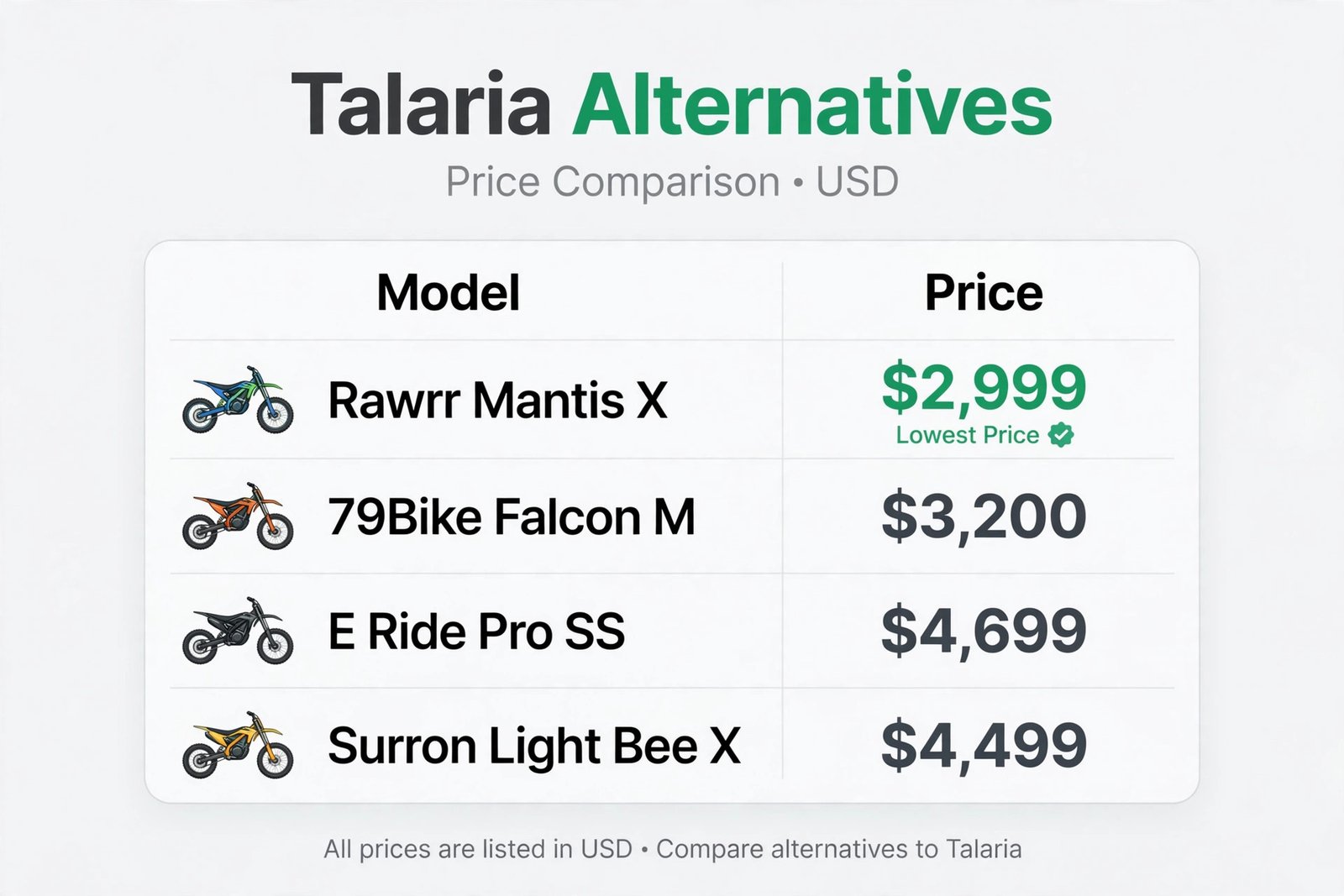
The best Talaria alternative depends on what you want the Sting for — and on what you are trying to escape. If the Sting’s price is the problem, the Rawrr Mantis X at $2,999 and the 79Bike Falcon M at $3,200–$3,500 give you a 72V bike for $1,000–$1,500 less than a Sting R MX4. If power is the problem, the E Ride Pro SS 3.0 at $4,699–$4,999 gives you 15.8 kW and a 3,600 Wh pack for roughly the same money as a Sting MX5 Pro, and the Surron Ultra Bee gives you a bigger chassis and a deeper aftermarket. If you want the closest thing to a Sting for less money, the Surron Light Bee X is the obvious answer — and if you want more bike for the same money, the E Ride Pro SS is the one to look at first.
This guide compares the five best Talaria alternatives on price, power, battery, weight, top speed, and real-world range, picks the best alternative for each type of rider, explains honestly what you lose by leaving Talaria (the gearbox, the dealer support, the resale), and what you gain (price, power, features) — so you can decide whether to buy the Sting or to buy something else.
Prices and specs checked Nov 2026. Prices vary by dealer, trim, and stock. Every price in this guide is a range from live listings checked in Nov 2026. Confirm the out-the-door price with a dealer before buying. No bike in this guide has been ridden by PumpFlow for this article — the comparisons are based on verified manufacturer and dealer specifications and on owner-reported real-world figures, not on a test ride.
Why Look Beyond Talaria?
The Talaria Sting is a good bike. The Sting R MX4 is a well-engineered, well-supported trail bike with a gearbox drive, a removable 60V 45Ah pack, and a large owner community. The Sting MX5 Pro is a genuinely strong 72V bike. Nobody needs to talk you out of a Sting. But there are four legitimate reasons to look at alternatives:
- Price. A Sting R MX4 costs roughly $3,799–$4,500, and an MX5 Pro roughly $4,600–$4,990. A Rawrr Mantis X costs $2,999 and a 79Bike Falcon M $3,200–$3,500 — both 72V bikes, both with similar or better specs on paper, for $1,000+ less.
- Power. The Sting R MX4 is an 8 kW bike. The E Ride Pro SS 3.0 is a 15.8 kW bike for roughly the same money as an MX5 Pro. If power is what you want, Talaria is not the most powerful bike at its price.
- Availability and dealer network. Talaria’s dealer network is good but not everywhere, and some models are out of stock at times. A Surron or an E Ride Pro may be available locally when a Talaria is not.
- Features. Some alternatives offer features the Sting does not — a larger battery, a belt drive with no gearbox oil to change, an app with tuning, or a lower seat height.
The reasons to stay with Talaria are also real, and they are covered in the “what you lose” section below. The point of this guide is not to say Talaria is bad — it is to say that, at Talaria’s price, there are bikes that give you more for the same money, or the same for less money, and you should know about them before you pay.
Comparison Table: The 5 Best Talaria Alternatives
| Bike | Price (Nov 2026) | Peak power | Battery | Top speed (claimed) | Real-world trail range | Weight |
|---|---|---|---|---|---|---|
| Talaria Sting R MX4 (for reference) | $3,799–$4,500 | 8 kW | 60V 45Ah, 2,700 Wh | ~55 mph | 25–40 mi | ~143–146 lb |
| Talaria Sting MX5 Pro (for reference) | $4,600–$4,990 | 13.4 kW | 72V 40Ah, 2,880 Wh | ~60 mph | 25–40 mi | ~163 lb |
| Surron Light Bee X (2026) | $3,899–$5,500 | 10 kW | 72V 35Ah, ~2,500 Wh | ~47 mph | 22–35 mi | ~126 lb |
| E Ride Pro SS 3.0 | $4,699–$4,999 | 15.8 kW | 72V 50Ah, 3,600 Wh | ~62 mph | 35–50 mi | ~167 lb |
| Rawrr Mantis X | $2,999 | 6.5 kW | 72V 30Ah, 2,160 Wh | ~50 mph | 25–35 mi (Eco) | ~139 lb |
| 79Bike Falcon M | $3,200–$3,500 | 8 kW | 72V 35Ah, 2,520 Wh | ~50 mph | 30–40 mi | ~130 lb |
| Valtinsu EM-5 Pro | $1,699 | 5.6 kW peak | 60V 27Ah, 1,620 Wh | ~52 mph | 30–40 mi (claimed) | ~143 lb |
Notes on the table: “claimed” top speeds are manufacturer claims, often at unrestricted / off-road settings — the bikes ship factory-limited to 20 mph in the US and the headline speeds assume the limiter is removed for off-road use, which has legal and warranty implications (see the note in the FAQ). Real-world range figures are planning estimates for mixed trail riding, not the manufacturer’s low-speed test figures. The Valtinsu EM-5 Pro is included as a budget pick, but its 1,620 Wh pack is significantly smaller than the others — it is a cheaper bike, not an equal bike.
The Alternatives in Detail
1. Surron Light Bee X — The Closest Alternative
Price: $3,899–$5,500 (most listings $4,400–$4,600). Best for: riders who want the closest thing to a Sting, with the deepest aftermarket.
The Light Bee X is the most obvious Talaria alternative because it is the bike the Sting was designed to compete with. The 2026 Light Bee X is a 72V bike with 10 kW peak, a 2,500 Wh pack, and a top speed around 47 mph. It is lighter than the Sting R (about 126 lb vs 143–146 lb), which makes it more playful on tight trails, and it has the deepest aftermarket of any electric dirt bike — more parts, more upgrades, more owner knowledge, and more dealers than any other bike in this guide.
What you gain vs a Sting R: a lighter bike, a bigger aftermarket, a larger dealer network, and better resale. What you lose: the Sting’s gearbox drive (the Surron is chain drive), some range (the Light Bee X’s pack is smaller, so its real-world trail range is roughly 22–35 miles vs the Sting R’s 25–40), and some low-end torque. Verdict: if you want a Sting but the dealer is far away or the price is high, the Light Bee X is the safe alternative. It is not more powerful, and it is not cheaper in any meaningful way — it is the same money for a different set of strengths.
2. E Ride Pro SS 3.0 — The Most Powerful Alternative
Price: $4,699–$4,999. Best for: riders who want more power and more range than a Sting, for MX5 money.
The SS 3.0 is the strongest alternative in this guide on paper, and it is the one that makes the Sting look expensive. It has a 15.8 kW peak motor (vs 8 kW for the Sting R and 13.4 kW for the MX5 Pro), a 72V 50Ah pack with 3,600 Wh (vs 2,700 Wh for the Sting R and 2,880 Wh for the MX5 Pro), a claimed top speed of 62 mph, and a real-world mixed-trail range of roughly 35–50 miles — the best in this guide. It has a belt drive (no gearbox oil, no chain to lube), a swappable battery, and a 0–30 mph time of about 2 seconds.
What you gain vs a Sting: far more power, far more range, a bigger battery, and a belt drive that is simpler to maintain. What you lose: the Sting’s gearbox feel, Talaria’s dealer network (E Ride Pro’s network is smaller, though growing), and some of the Sting’s refinement — the SS is a more raw, more powerful bike, and its weight (167 lb) is higher than the Sting R’s. Verdict: if you are choosing between a Sting MX5 Pro ($4,600–$4,990) and an SS 3.0 ($4,699–$4,999) at the same price, the SS 3.0 gives you more power and more range for the same money. That is the strongest value argument in this guide.
The older SS 2.0 (12 kW, 72V 40Ah, 2,880 Wh, $4,599 plus $300 shipping) is still available in places and is a good buy if you find it discounted, but the SS 3.0 is the current model and the better buy at a similar price.
3. Rawrr Mantis X — The Cheapest Real Alternative
Price: $2,999. Best for: budget buyers who want a real 72V trail bike for $1,000+ less than a Sting.
The Mantis X is the cheapest full-size-ish e-moto in this guide, and it is a real bike, not a toy. It has a 72V 30Ah pack (2,160 Wh), a 6.5 kW peak motor, a claimed top speed of 50 mph, a claimed range of 62 miles in Eco mode (real-world mixed trail roughly 25–35 miles), and a weight of 139 lb. It has a swappable battery, an app-connected controller, Eco / Sport / Race modes, and a 220 lb weight capacity.
What you gain vs a Sting R: you save $800–$1,500, you get a 72V platform, and you get a lighter, simpler bike. What you lose: power (6.5 kW vs 8 kW), range (the 2,160 Wh pack is smaller than the Sting R’s 2,700 Wh), and the Sting’s dealer network and aftermarket — Rawrr’s network is smaller, and the Mantis X has a 70 mm rear travel that is short for rough trails. The 220 lb weight capacity is also a limit for heavier riders. Verdict: the Mantis X is the best Talaria alternative if the budget is the deciding factor. It is not as powerful or as long-ranged as the Sting R, but it is a real trail bike for $2,999, and that is a genuine saving.
4. 79Bike Falcon M — The 72V Value Alternative
Price: $3,200–$3,500 (some listings show the Falcon M as discontinued in favour of the Falcon Pro at $3,599–$3,799 — check availability before you decide). Best for: riders who want a 72V bike with a big battery for Sting R money, or less.
The Falcon M has a 72V 35Ah LG pack (2,520 Wh), an 8 kW peak motor (4 kW rated), a claimed top speed around 50 mph, a claimed range up to 75 miles in Eco mode (real-world mixed trail roughly 30–40 miles), and 19-inch wheels at both ends. It has NFC phone unlock, a belt-chain hybrid drivetrain, and a 3.5-hour charge time.
What you gain vs a Sting R: a 72V platform, a similar power figure, and a price $300–$1,300 lower. What you lose: the Sting’s dealer network and aftermarket are far deeper — 79Bike is a newer brand, its US dealer network is still building (through partners like Electric Ride Co and Amped Bikes), and the Falcon M’s availability is uncertain (some sources list it as discontinued, with the Falcon Pro as the current model). Verdict: the Falcon M is a strong value bike on paper, but check that you can actually buy one, get parts, and get support locally before you choose it over a Sting. If you can, it is a good buy. If you cannot, the Surron or the Rawrr is the safer choice.
5. Valtinsu EM-5 Pro — The Budget Pick (With a Caveat)
Price: $1,699. Best for: experienced adults who want the cheapest way into a fast e-moto and understand the trade-offs.
The EM-5 Pro is a 60V bike with a 5.6 kW peak motor, a 60V 27Ah pack (1,620 Wh), a claimed top speed of 52 mph, and a claimed range up to 59 miles. It is a direct-to-consumer bike, and its price is its argument: $1,699 is less than half a Sting R.
The caveat: the 1,620 Wh pack is significantly smaller than the Sting R’s 2,700 Wh pack, so its real-world range and its ability to sustain power on a long trail ride are lower. It is a budget bike, and it should be judged as one — it is not a Sting R for half the price, it is a different, cheaper bike that is fast and fun for shorter rides. Verdict: a legitimate budget pick if you understand what you are giving up, and if you have a local source for parts and support. Not a like-for-like Sting replacement.
Pick by Rider: Which Alternative for You?
| Rider | Best Talaria alternative | Why |
|---|---|---|
| Budget buyer (under $3,000) | Rawrr Mantis X ($2,999) | Real 72V trail bike, $1,000+ less than a Sting R. |
| Budget buyer (under $2,000) | Valtinsu EM-5 Pro ($1,699) | Cheapest fast e-moto here, with a smaller pack — understand the trade-off. |
| Power seeker | E Ride Pro SS 3.0 ($4,699–$4,999) | 15.8 kW and 3,600 Wh for MX5 money. The most bike for the money. |
| Trail rider who wants the deepest aftermarket | Surron Light Bee X ($3,899–$5,500) | Lightest bike here, biggest parts and owner community. |
| Long-range rider | E Ride Pro SS 3.0 | 35–50 miles of real trail range — the best in this guide. |
| Beginner | Rawrr Mantis X or Surron Light Bee X | Light, manageable, and (for the Rawrr) cheap enough that a drop is not a disaster. |
| Heavier rider (over 220 lb) | E Ride Pro SS 3.0 or Surron Ultra Bee | Check the weight capacity — the Rawrr Mantis X is limited to 220 lb, and the Sting R is not a heavy-rider bike either. |
What You Lose vs a Sting
Leaving Talaria costs you things that do not show up in a spec table, and you should weigh them honestly:
- The gearbox. The Sting’s enclosed gearbox drive is a defining feature. It gives smooth, quiet power, it is protected from mud and stones, and it is a reason many owners choose Talaria over a chain-drive bike. The E Ride Pro’s belt drive is also low-maintenance, but it is not the same feel. The Surron and the Rawrr are chain drive, which needs more maintenance.
- Dealer support. Talaria has a real dealer network, and a dealer who can diagnose a battery, replace a BMS, and handle a warranty claim is worth money when something goes wrong. Newer brands (79Bike, Valtinsu, Rawrr) have thinner networks, and you may be relying on the seller or on mail-order parts.
- Resale. A Talaria (and a Surron) holds its value better than a newer, less-known brand. A 79Bike or a Valtinsu will be harder to sell in two years, and the price will be lower. If you change bikes often, that matters.
- Aftermarket depth. Talaria and Surron have large aftermarkets — tyres, suspension, seats, foot pegs, and performance parts are easy to find. The alternatives have smaller aftermarkets, and some parts may be hard to source.
- Refinement. The Sting is a refined bike — the power delivery, the suspension, and the build quality are consistent. Some cheaper alternatives are less refined, with rougher power delivery or cheaper components in places you do not see on a spec sheet.
What You Gain: Price, Power, Features
- Price. The Rawrr saves you $800–$1,500 over a Sting R. The Valtinsu saves you $2,000+. That is real money, and it buys gear, a spare battery, or a season of riding.
- Power. The E Ride Pro SS 3.0 gives you 15.8 kW for MX5 money — almost double the Sting R’s power and more than the MX5 Pro’s.
- Range. The SS 3.0’s 3,600 Wh pack gives you 35–50 miles of real trail range, vs 25–40 for the Sting R. That is a meaningful difference on a long ride.
- Features. A swappable battery (E Ride Pro, Rawrr, 79Bike), a belt drive with no gearbox oil (E Ride Pro), an app with tuning (Rawrr, 79Bike), and a lower price for the same 72V platform (Rawrr, 79Bike).
Used Talaria vs New Alternative: The Honest Trade-Off
This is the decision many buyers actually face: a used Sting R for $2,500–$3,500, or a new Rawrr Mantis X for $2,999, or a new 79Bike Falcon M for $3,200–$3,500.
- A used Sting R with a verified healthy battery is a good buy. You get the Talaria gearbox, the dealer network, and the resale, for the price of a new Rawrr. The battery check is non-negotiable — see How to Check Surron Battery Health (planned; the same principles apply to Talaria packs).
- A used Sting R with an unknown or weak battery is not a good buy. A replacement pack is a four-figure cost, and it wipes out the saving.
- A new Rawrr or 79Bike gives you a warranty, a new battery, and a known history, for the same money as a used Sting. If the used Sting’s battery is uncertain, the new alternative is the safer buy.
Verdict: Who Should Still Buy the Talaria?
Buy the Talaria Sting if: you want the gearbox drive, you have a good Talaria dealer nearby, you value resale and the aftermarket, and you are happy with the Sting R’s power and range for the price. The Sting R is a good bike, and the MX5 Pro is a strong bike — neither is a bad buy.
Buy an alternative if: the price is the barrier (Rawrr Mantis X), you want more power and range for the same money (E Ride Pro SS 3.0), you want the deepest aftermarket and the lightest bike (Surron Light Bee X), or you want a 72V bike for less than a Sting R (79Bike Falcon M, if you can buy one locally with support).
The single strongest alternative in this guide is the E Ride Pro SS 3.0 for a buyer choosing between it and a Sting MX5 Pro at the same price, and the Rawrr Mantis X for a buyer whose budget is the deciding factor. Both are legitimate, verified alternatives — not cheap copies.
Buying Checklist (for Any Alternative)
- Confirm the model year, voltage, and peak power in writing.
- Confirm the out-the-door price (tax, freight, setup) — not just the listed price.
- Confirm the dealer / seller can provide parts, a battery diagnosis, and warranty support.
- Check the weight capacity if you are a heavier rider.
- Test-ride if you can — power delivery and ergonomics do not show up on a spec sheet.
- Check the battery health if buying used, and price a replacement pack before you negotiate.
- Check local rules on where you can ride — these are off-road bikes, and road legality varies by state/country. Check local rules; do not assume a dealer can make it road-legal.
FAQ: Best Talaria Alternatives
What is the best alternative to a Talaria Sting?
It depends on your priority: the E Ride Pro SS 3.0 is the best for power and range at MX5 money ($4,699–$4,999, 15.8 kW, 3,600 Wh); the Rawrr Mantis X is the best for budget ($2,999, 72V); and the Surron Light Bee X is the best for the deepest aftermarket and the lightest bike.
What is cheaper than a Talaria Sting but just as good?
The Rawrr Mantis X ($2,999) and the 79Bike Falcon M ($3,200–$3,500) are both 72V bikes for $800–$1,500 less than a Sting R MX4. They are not identical to the Sting — the Rawrr has less power and a smaller pack, and the 79Bike has a thinner dealer network — but they are real trail bikes, not toys.
Is the E Ride Pro SS better than the Talaria Sting?
On power and range, yes — the SS 3.0 has 15.8 kW and a 3,600 Wh pack, vs 8 kW and 2,700 Wh for the Sting R, and 13.4 kW and 2,880 Wh for the MX5 Pro. On dealer network, aftermarket, and resale, the Talaria (and the Surron) are stronger. Which is “better” depends on whether you value power or support more.
Is the Surron Light Bee X a good alternative to the Talaria Sting?
Yes — it is the closest alternative, with a lighter bike, a bigger aftermarket, and a larger dealer network. It has less range than the Sting R (smaller pack) and it is chain drive rather than gearbox drive, but it is a proven, well-supported bike.
Is the Rawrr Mantis X a good Talaria alternative?
Yes, for budget buyers. At $2,999 it is a real 72V trail bike with a swappable battery and a 50 mph top speed. It has less power (6.5 kW) and a smaller pack (2,160 Wh) than the Sting R, and a 220 lb weight limit, but it saves you $800–$1,500.
What do I lose by buying a Talaria alternative instead of a Sting?
You lose the Sting’s gearbox drive, some dealer support and aftermarket depth (depending on the brand), and some resale value. You gain price, power, or range, depending on the alternative.
Should I buy a used Talaria or a new alternative?
A used Talaria with a verified healthy battery is a good buy. A used Talaria with an unknown battery is not — price a replacement pack before you negotiate. A new alternative gives you a warranty and a new battery for the same money, and it is the safer buy if the used bike’s battery is uncertain.
Are Talaria alternatives road-legal?
These are off-road bikes, sold as off-road vehicles. Road legality varies by state and country, and it is not guaranteed for any of them. Check your local rules and your state DMV — do not assume a dealer can make any of these bikes road-legal, and do not ride on public roads where it is not allowed.
Which Talaria alternative has the longest range?
The E Ride Pro SS 3.0, with a 3,600 Wh pack and roughly 35–50 miles of real mixed-trail range. The Sting R is 25–40 miles, the Light Bee X is 22–35 miles, and the Rawrr Mantis X is roughly 25–35 miles.
Which Talaria alternative is best for a beginner?
The Rawrr Mantis X (cheap, light, and manageable) or the Surron Light Bee X (light, well-supported, and with a huge owner community to learn from). Both are easier to live with as a first bike than a high-power SS 3.0 or an MX5 Pro.
Conclusion
The best Talaria alternative is not one bike — it is the bike that matches what you actually want. If you want more power and range for MX5 money, buy the E Ride Pro SS 3.0. If you want a real 72V trail bike for $2,999, buy the Rawrr Mantis X. If you want the closest thing to a Sting with the deepest support, buy the Surron Light Bee X. And if you want the gearbox, the dealer, and the resale, buy the Talaria — it is still a good bike, and this guide is not telling you not to. It is telling you what else your money buys, so you can choose with your eyes open.
Read next:
- Best Surron Alternatives (2026) — planned in this build
- How Much Does a Surron Cost in 2026? — planned in this build
- Talaria Sting R Range: Real-World Miles — planned in this build
- Talaria review — existing PumpFlow review (check live slug before publishing)
- Surron review — existing PumpFlow review (check live slug before publishing)
- E Ride Pro review — existing PumpFlow review (check live slug before publishing)
- Battery Guide — existing PumpFlow guide
Prices and specifications checked Nov 2026 from manufacturer and dealer listings. Prices vary by dealer, trim, and stock — confirm the out-the-door price before buying. No bike in this guide was test-ridden by PumpFlow for this article.